

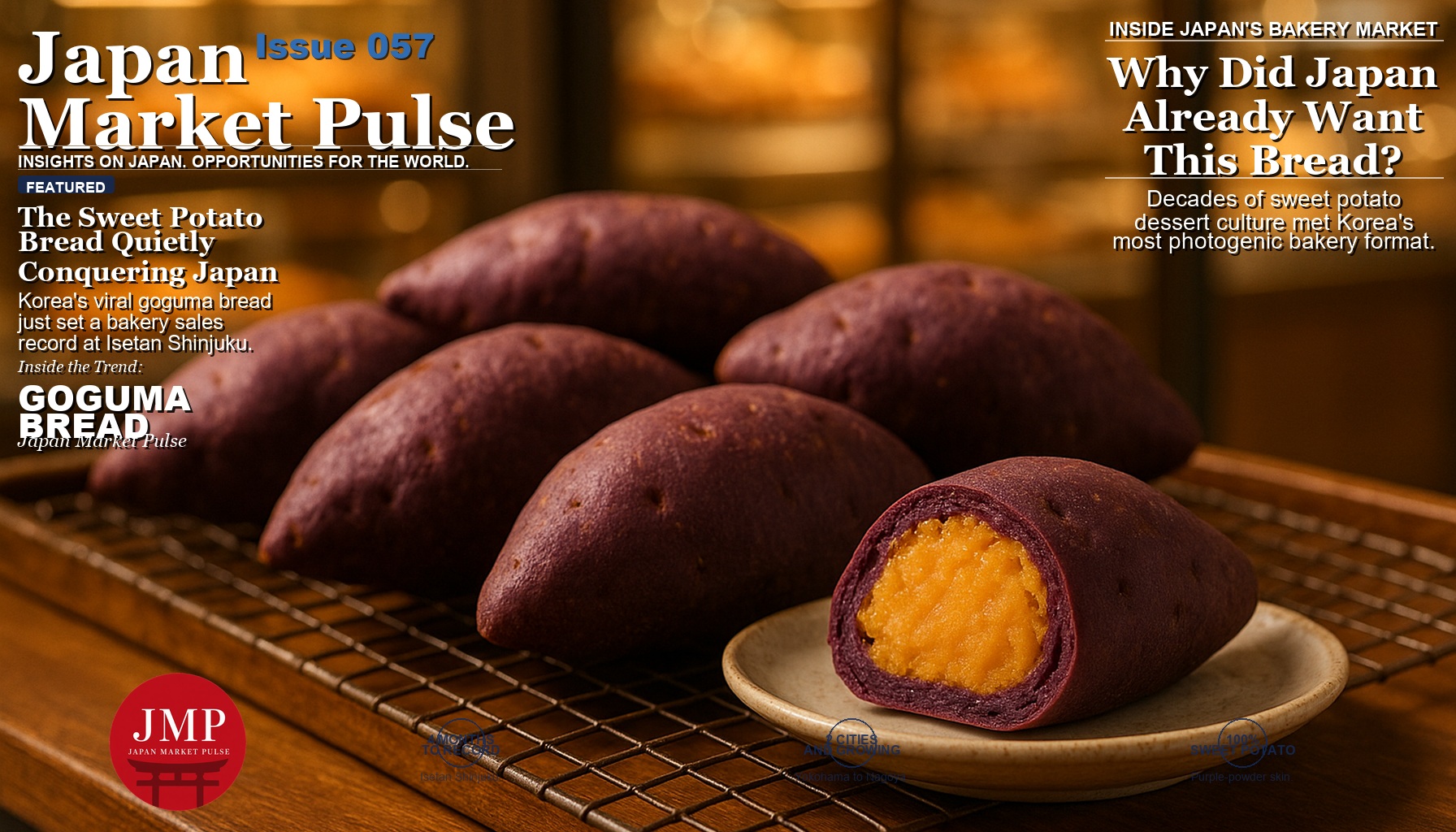
I first ran into goguma bread on a Tuesday afternoon in a department store basement, which is exactly where a trend like this is supposed to be discovered in Japan. I wasn’t looking for it. I was hunting for a gift box of senbei for a client meeting when a line of about fifteen people, mostly women in their twenties, stopped me cold in the middle of Isetan’s food hall. They were queuing for something that, from a distance, looked like actual sweet potatoes stacked in a glass case — skin and all, purplish-brown and slightly knobby. It took me a second look to realize they were bread. Chewy, mochi-textured, filled with a honeyed sweet potato mousse, and dusted in purple sweet potato powder to complete the illusion. The Korean name is goguma-ppang, or 고구마빵, and after twenty years of watching food trends cross the Sea of Japan in both directions, I can say this one is different. It isn’t just popular. It’s landing in a market that was already primed to want it, for reasons that have very little to do with Korea and everything to do with Japan’s own relationship with the humble sweet potato.
For anyone who tracks consumer trends professionally — and especially anyone thinking about what comes after K-beauty in the pipeline of Korean cultural exports — goguma bread is worth a closer look. It’s a small, inexpensive, extremely photogenic product, and it’s currently doing the same thing K-beauty brands like Anua did a few years back: building real commercial traction in Japan through department store pop-ups and organic social proof before anyone in the West has quite clocked what’s happening. Here’s what’s actually going on, and why the mechanics behind it matter more than the bread itself.
1. The Bread That Looks Exactly Like What It’s Made Of
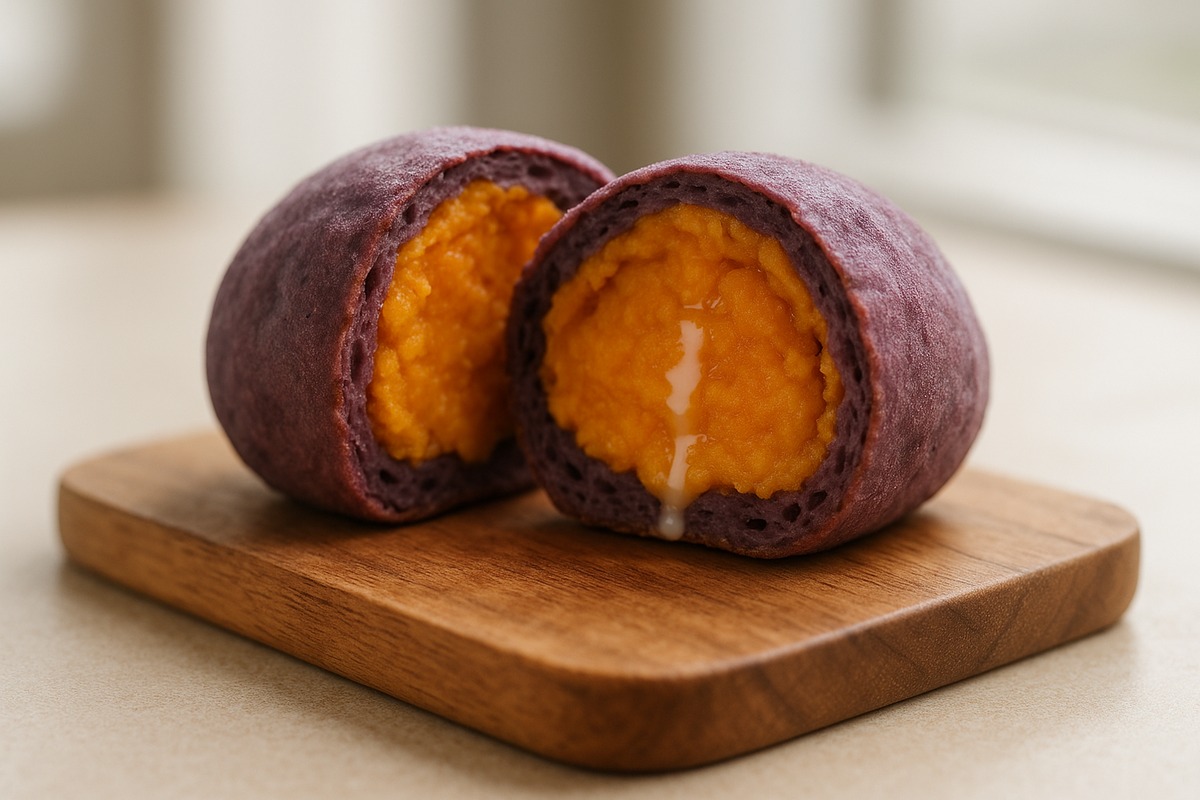
To understand goguma bread, you have to understand its older sibling first. Korea’s viral bakery scene over the past several years has been dominated by what I’d call "shape-accurate" bread — products engineered to look, uncannily, like the raw ingredient inside them. The category was essentially created by a company called Gamzabat, an agricultural venture out of Chuncheon, a small city a couple of hours from Seoul that is otherwise known mostly for dakgalbi and a scenic lake. Gamzabat’s original product, gamja-ppang (potato bread), uses a chewy tapioca-based dough that’s baked, dusted with cocoa, and shaped to look like an actual russet potato, complete with the little divots and blemishes. Cut it open and there’s a cream cheese or custard filling inside. It became one of those products that spreads because people can’t resist filming the reveal.
Goguma bread is the sweet potato cousin, and in some ways it’s a more natural fit for the format. Where potato bread relies on cocoa powder to fake a brown skin, sweet potato bread uses actual purple sweet potato powder, so the "skin" tastes like something rather than just looking like something. The dough is typically a mix of tapioca starch and wheat flour, which gives it that stretchy, slightly gummy chew that’s become a signature texture across Korean bakeries — think somewhere between mochi and a dense brioche. Inside, bakers pipe in a mash of honey-roasted sweet potato, sometimes finished with a thread of condensed milk or a scoop of mascarpone. Major Korean chains, including Tous Les Jours and Hollys Coffee, now run seasonal goguma bread promotions that generate the kind of anticipation Americans reserve for pumpkin spice season — limited runs, flavor variants with black sesame or matcha swirled through the mousse, and lines that form the moment a new batch comes out of the oven.
What makes this relevant to Japan isn’t the bread’s popularity in Korea, which has been building for a few years now. It’s the fact that the format has started making the jump across the strait — and the way it’s making that jump tells you something important about how Korean consumer products actually break into the Japanese market.
2. The Department Store Proof: A Bread That Set a Sales Record in Isetan
Japan doesn’t let foreign food trends walk in through the front door. It makes them earn a seat at the depachika counter first — the basement food halls of major department stores like Isetan, Takashimaya, and Mitsukoshi, which have functioned for decades as the country’s most rigorous proving ground for new food products. If a product can’t sell in a depachika pop-up, it generally doesn’t get a second life in convenience stores or mainstream cafés. It’s a brutal filter, and it’s exactly the filter Gamzabat cleared first with its original potato bread, well before goguma bread rode the same channel into Japan.
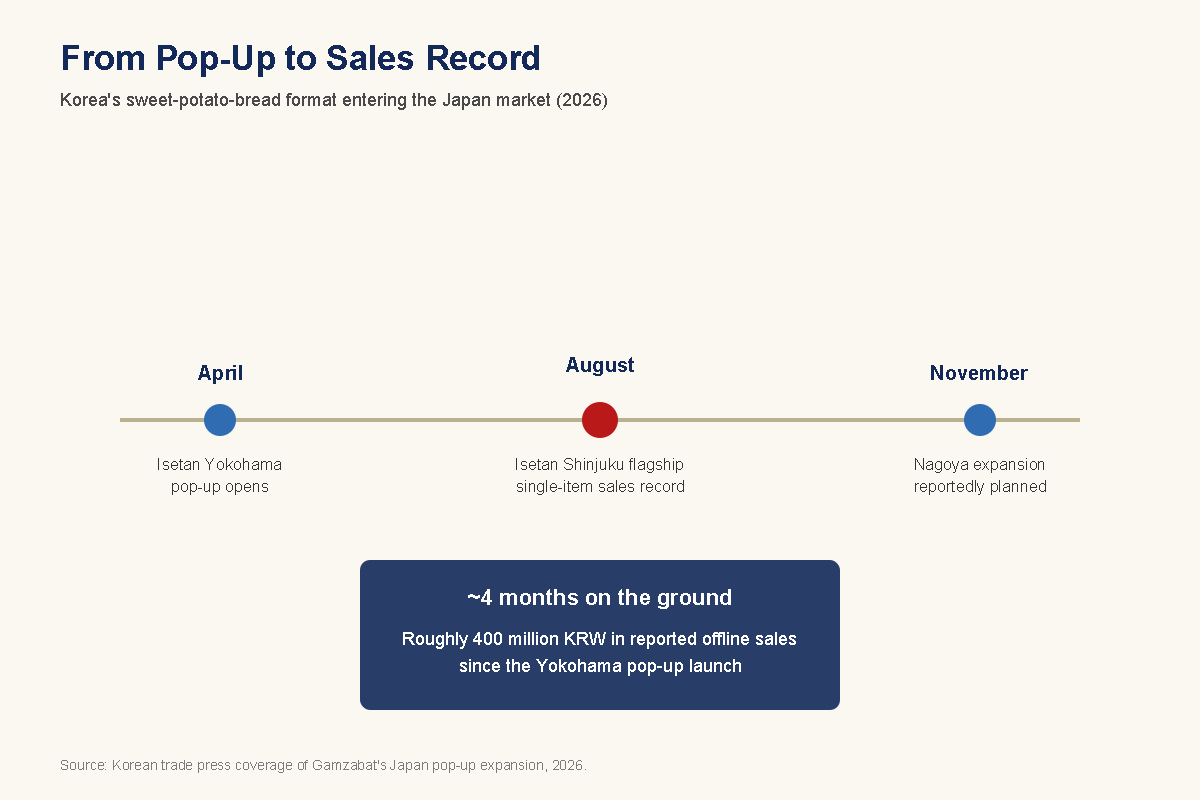
The company opened its first Japanese storefront at Isetan Yokohama in April 2025, and by mid-August of that year had expanded into a pop-up at the flagship Isetan Shinjuku location — arguably the single most competitive retail food floor in the country, complete with an opening-day line long enough to draw local press and celebrity sightings. Korean trade coverage of the launch described the Yokohama store as setting daily sales records for the category, and a Nagoya location has reportedly been in the company’s plans for after the Shinjuku pop-up wraps, though the exact timing hasn’t been pinned down in the reporting I could verify. I’m not going to attach a precise revenue figure to this, because the specific numbers circulating are not something I could independently confirm to my own standard — but the qualitative signal (daily record sales, opening-day queues, expansion to a second and now third flagship location within roughly a year) is well documented. None of this is enormous by the standards of a national fast-food rollout, but for a niche bakery item sold through pop-up counters, it’s a genuinely strong signal — the kind of number that gets noticed by procurement teams at competing retailers, and the kind that tends to accelerate copycat activity across the industry within a season or two.
I want to be careful here not to overstate a single company’s numbers into a sweeping market claim, and I also want to be precise about which product did the hard work first: it was the original potato bread that cleared the depachika gate in 2025, with sweet potato bread following as a companion item in the same stores and the same pop-up rollout. What I can say with more confidence, having watched a fair number of Korean food products attempt this exact crossing over the years, is that the depachika-to-mainstream pipeline is a well-worn one in Japan, and goguma bread has ridden its sibling product’s momentum through the first and hardest gate.
3. Why Japan Was Already Primed to Fall for This

Here’s the part of the story that I think gets missed if you’re looking at this purely as a K-culture export story: Japan didn’t need to be convinced that sweet potatoes belong in dessert form. It’s been building that case to itself for years.
Walk through any Japanese supermarket in autumn and you’ll find an entire aisle dedicated to satsumaimo — the local sweet potato variety — in forms ranging from roasted street-cart yakiimo to daigaku-imo (candied sweet potato cubes) to imo-yokan and imo-mochi. Convenience store chains run seasonal sweet potato dessert lineups every single year, and department stores host dedicated sweet potato festivals; the "Satsumaimo Haku" summer event at Makuhari Messe pulls in two dozen specialty roasters and bakers for a multi-day event that draws serious crowds, and a winter edition runs the same playbook a few months later. There are café concepts built entirely around imo desserts, and a "yaki-imo grand prix" that crowns a national champion roaster every year with genuine media coverage. None of this is a recent fad. Sweet potato has occupied roughly the same cultural real estate in Japan that pumpkin spice occupies in North America — a reliable, nostalgic, slightly wholesome flavor that consumers return to season after season without needing to be sold on it.
That’s the soil goguma bread landed in. A Japanese consumer encountering it for the first time isn’t being asked to try something genuinely foreign, the way they might be asked to try, say, tteokbokki or budae-jjigae. They’re being asked to try a Korean reinterpretation of a flavor they already trust, wrapped in a format — the mochi-tapioca shell — that Japan’s own confectionery culture (mochi, daifuku, warabi-mochi) has spent centuries training consumers to enjoy. It’s a low-risk trial dressed up as a novelty, which is close to the ideal condition for a food trend to spread quickly. This is a pattern worth remembering if you’re evaluating any Korean product for the Japanese market: the products that cross over fastest tend to be reinterpretations of something the consumer already trusts, not genuinely unfamiliar concepts.
4. The Cheap Coffee War That Could Carry This Further Than a Pop-Up

There’s a second force worth watching, and it’s less about bread and more about coffee. Korea’s discount coffee sector has become one of the country’s more aggressive exporters of retail concepts over the past two years. Chains like Compose Coffee and Mega Coffee MGC built their domestic businesses on a simple formula — very cheap coffee, high store density, low overhead — and having largely saturated the Korean market, they’re now pushing outward. Compose Coffee has already opened locations in Singapore and, more recently, Taipei, with plans to scale to roughly ten Taiwanese stores by year’s end. Trade press has also reported that Paik’s Coffee (빽다방), the chain built around celebrity restaurateur Baek Jong-won’s brand, is targeting a first Japanese location in the second half of this year.
Why does this matter for a sweet potato bread story? Because these chains have historically used visually distinctive bakery items — cream-heavy pastries, oversized sandwiches, novelty drinks — as loss-leading traffic drivers that get photographed and shared far more than they get profited from directly. A shape-accurate sweet potato bread, sold at a price point that undercuts a boutique bakery, is exactly the kind of item that fits this playbook. If even one of these chains lands meaningfully in Japan and puts goguma bread or something like it on the counter, the trend moves from "department store pop-up curiosity" to "thing available on your commute," which is a very different order of market penetration. I’d treat this as a real possibility rather than a certainty — Japan’s café market is famously difficult for foreign entrants, dominated by domestic giants and a fiercely loyal independent kissaten culture — but it’s the mechanism to watch if you want an early signal that this trend is moving from niche to mainstream.
5. Built for the Feed: Why This Bread Photographs Better Than It Sells
No discussion of a Korean food export in 2026 is complete without acknowledging the role of the phone camera, because in this case it’s arguably doing more commercial work than the product itself. Korean bakery culture over the last several years has increasingly optimized for what happens after purchase rather than during it: the cross-section reveal, the steam rising off a fresh-cut loaf, the slow-motion cheese pull. Goguma bread was practically engineered for this moment — cut one open and the contrast between the dark purple exterior and the bright orange-gold mousse inside is the kind of visual that performs well on a For You page with almost no additional editing required.
I’ve written before in this newsletter about how Anua and other K-beauty brands built their Japanese and Western followings less through traditional advertising and more through a steady accumulation of organic, unpaid content — reviewers filming unboxings, skincare routines, and side-by-side comparisons that functioned as free, credible advertising at a scale no media budget could buy. Goguma bread is following an almost identical playbook, just in a different aisle of the store. A twenty-something in Shibuya filming the cross-section cut on her lunch break is doing the same marketing job that a K-beauty unboxing video does — creating a form of social proof that reaches a much younger, much more skeptical-of-advertising audience than a traditional campaign ever could. If you’re trying to understand why Korean consumer products keep outperforming expectations in markets they enter with minimal formal marketing spend, this is a large part of the answer: the products themselves are increasingly designed to be content, not just goods.
6. What This Means If You Sell, Source, or Distribute Into Japan
For readers of this newsletter who operate in food, retail, or import-export more broadly, there are a few practical takeaways buried in this story that go beyond "sweet potato bread is popular."
First, the depachika pop-up remains one of the most reliable low-risk entry points for a food product into the Japanese market, and it’s worth studying as a template regardless of category. A short-term counter lease inside a trusted department store gives a foreign brand access to a highly discerning customer base, immediate sales data, and a level of implicit quality endorsement that’s hard to buy through advertising. If you’re evaluating whether a product has real potential in Japan, a pop-up campaign of this kind is a far cheaper test than a permanent lease or a distribution deal.
Second, watch the ingredient supply chain quietly forming behind this trend. Tapioca starch and purple sweet potato powder are the two inputs that make this format work, and as more bakeries — Korean-owned and Japanese copycats alike — chase the visual, demand for both will tick upward. There’s a reasonable opening here for specialty ingredient importers who can secure reliable, food-safety-compliant supply chains for these inputs ahead of the curve, rather than scrambling once demand has already peaked.
Third, expect fast domestic imitation, and expect it to be a double-edged sword. Japanese bakeries are extremely quick studies when a format proves itself — within a season or two of a viral product’s arrival, you typically see convenience store chains, regional bakery groups, and independent shops all releasing their own versions, often using entirely domestic satsumaimo rather than imported Korean branding. That’s good for the category’s staying power in Japan, since it stops being dependent on a single import relationship, but it also means the original Korean brand’s window to capture premium margin before the format gets commoditized is relatively short. Anyone licensing or distributing the authentic product needs to move with real urgency in year one, because year two almost always brings a flood of local competitors selling a visually similar item at a lower price point.
7. The Real Question: Will It Outlast the Hype?
It’s worth being honest about the risk here too. Viral Korean food exports have a mixed track record for longevity. Dalgona coffee swept the world in 2020 and essentially vanished within a year once the novelty of whipping instant coffee by hand wore off. Cloud bread had a similar arc — a burst of attention, an avalanche of home recreation videos, and then a fairly quick fade as the format turned out to be more interesting to look at than to eat regularly.
What makes me more optimistic about goguma bread’s staying power in Japan specifically is that it isn’t asking consumers to adopt a genuinely new habit. It’s slotting into an existing, well-established consumption pattern — buying a sweet potato treat as an autumn or anytime snack — rather than creating a new one from scratch. Trends built on top of existing habits tend to have longer half-lives than trends that require consumers to change their behavior entirely. That said, execution will decide the outcome. If the format gets diluted by a wave of low-quality copycats using cheap fillings and stale dough, the association with "premium seasonal treat" will erode quickly, and it’ll be remembered the way dalgona coffee is — as a fun month, not a lasting menu category. If the better operators maintain quality as the trend scales, there’s a real path for goguma bread to become a permanent, if modest, fixture of Japan’s café and convenience store landscape, the way daigaku-imo and imo-mochi already are.
Frequently Asked Questions
Q. Where can I actually find goguma bread in Japan right now?
A. The most reliable place to find the authentic Gamzabat-branded product is through its department store pop-ups, which launched at Isetan Yokohama in April 2025 and expanded to the flagship Isetan Shinjuku store by that August, with a Nagoya location reportedly in the company’s plans for after the Shinjuku run wraps. Beyond the official pop-ups, Korean-run cafés in areas with dense Korean-Japanese cultural traffic — Shin-Okubo in Tokyo, for example — have started carrying their own versions, and it’s reasonable to expect convenience store and regional bakery copycats to follow within the next year or two as the format proves itself.
Q. How much does it typically cost?
A. Pricing on the original Korean-import product at department store pop-ups tends to sit in a premium-snack range, generally a few hundred yen per piece — broadly comparable to a specialty bakery item rather than a convenience store dessert. Domestic copycat versions, when they arrive, will likely undercut that price point significantly, following the same pattern as most viral food formats that get locally reproduced.
Q. Is anything like this available outside Japan and Korea, including the US?
A. Not in its original form as a retail product, at least not yet — Gamzabat’s pop-ups have so far stayed within Japan and Korea, and shelf-stable versions occasionally surface through Asian grocery delivery services rather than mainstream retail. For home bakers curious about the tapioca-mochi technique that gives this bread its signature chew, imported baking mixes built on the same base, such as Beksul’s Korean Tapioca Bread Mix, are sold on Amazon and offer a reasonably close entry point to the format, even though they aren’t a direct substitute for the sweet-potato-specific product sold in Japan.
Q. Is goguma bread the same thing as the Korean "potato bread" I might have seen online?
A. They’re closely related but not identical. Potato bread (gamja-ppang) was the original viral format from the same Chuncheon-based company, using a cocoa-dusted shell to imitate a russet potato’s skin around a custard or cream cheese filling. Goguma bread is the sweet potato variation, using purple sweet potato powder for the skin and a honeyed sweet potato mousse filling, and it’s the version that appears to be resonating more strongly in Japan given the country’s existing enthusiasm for sweet potato desserts specifically.
Q. Could this trend expand into Western markets eventually?
A. It’s plausible but not close to imminent. The format’s early success has depended heavily on Korea’s and Japan’s shared retail infrastructure — department store pop-up culture, dense urban café density, and a consumer base primed by years of sweet potato dessert consumption — none of which map cleanly onto the US market in the same way. A more likely path west, if it happens, would run through Korean-American bakery chains already operating in cities like Los Angeles and New York, which have historically served as the first adopters of Korean bakery trends before they reach a broader American audience.
Conclusion
Standing in that Isetan basement, watching people photograph a piece of bread shaped like a vegetable before they’d even taken a bite, I found myself thinking less about the product and more about the pattern. Korea keeps exporting small, visually distinctive, socially shareable products into Japan — first beauty, now bakery — and each time, the products that succeed are the ones that graft themselves onto something Japanese consumers already trust, rather than asking them to embrace something wholly unfamiliar. Goguma bread isn’t reinventing what Japan eats. It’s giving Japanese consumers a new, more photogenic way to eat something they already loved, at a moment when the phone camera has become as important to a product’s success as the recipe itself. For anyone tracking where the next wave of Korean consumer exports might land — in food, beauty, or otherwise — that grafting mechanism, more than any single sales figure, is the thing worth watching closely.
This article contains affiliate links. If you purchase through these links, we may earn a small commission at no extra cost to you.
If you’re interested in this topic, the Japanese market more broadly, or what KETCHUPs is working on, we’d love to hear from you — please reach out via our contact form.
Japan Market Pulse is a weekly read on what the Japanese consumer-tech, food, and mobility markets are choosing to do, written for international operators who want to know what is happening before it shows up in the global trade press.
Subscribe at ketchups.co/japan-market-pulse.