

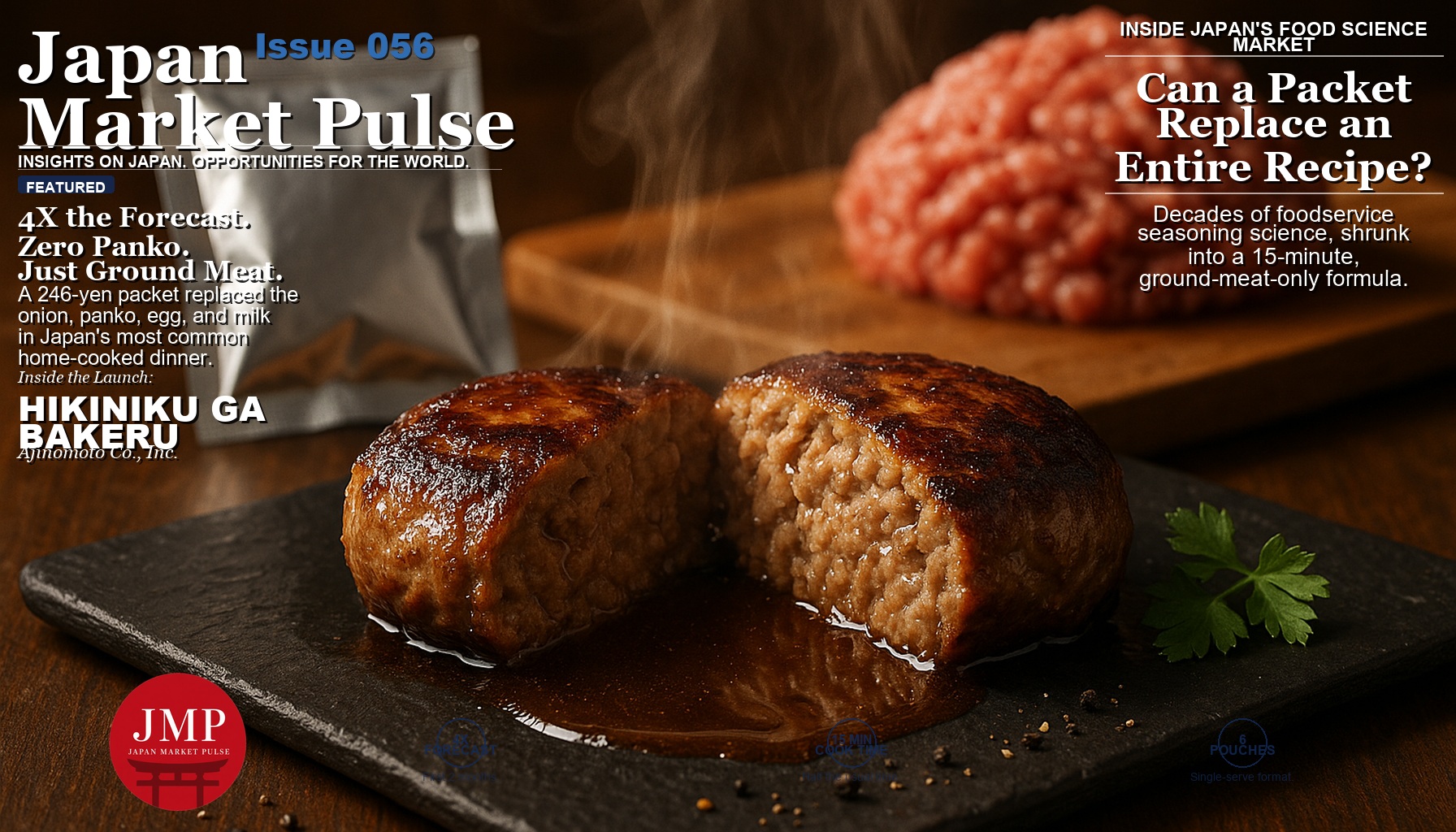
There is a specific kind of kitchen ritual that every household in Japan seems to inherit, whether they asked for it or not, and it is called hambagu — hamburger steak, the minced-meat patty smothered in demi-glace or ponzu that shows up on family dinner tables, school lunch trays, and convenience-store bento boxes with a consistency that borders on civic duty. I have lived in Japan for twenty years, and in that time I have made more of these patties than I can count, and every single one of them started the same tedious way: dice an onion fine enough that nobody complains about the texture, sauté it until it’s translucent and has cooled back down to room temperature so it doesn’t cook the raw meat prematurely, soak panko breadcrumbs in milk until they turn to paste, crack an egg, and then combine all of it with ground meat and knead it by hand until your fingers ache and the whole operation has eaten forty-five minutes of your evening before a single patty has touched a pan.
So when I tell you that a small foil packet costing 246 yen — roughly a dollar fifty at current exchange rates, with the yen trading near ¥162 to the dollar in mid-2026 — has quietly talked its way into becoming one of the more closely watched new product launches in Japan’s food industry this year, I want you to understand what it is actually replacing. It is not replacing a lazy shortcut. It is replacing an entire evening ritual that half the country still performs from memory, the way people who grew up baking know a pie crust recipe without looking at a card. And it did that well enough, fast enough, that it sold out its own two-month sales forecast four times over — a number that made even Ajinomoto’s own planners look conservative.
This is the story of "Hikiniku ga Bakeru" — roughly, "Ground Meat Transforms" — Ajinomoto’s Hamburg Seasoning, and why a seasoning packet that eliminates the onion, the panko, the egg, and the milk from Japan’s national comfort food might be one of the more instructive food-science stories to come out of Japan this year, whether or not you have ever personally made a hamburger steak in your life.
The Packet That Killed the Grocery List
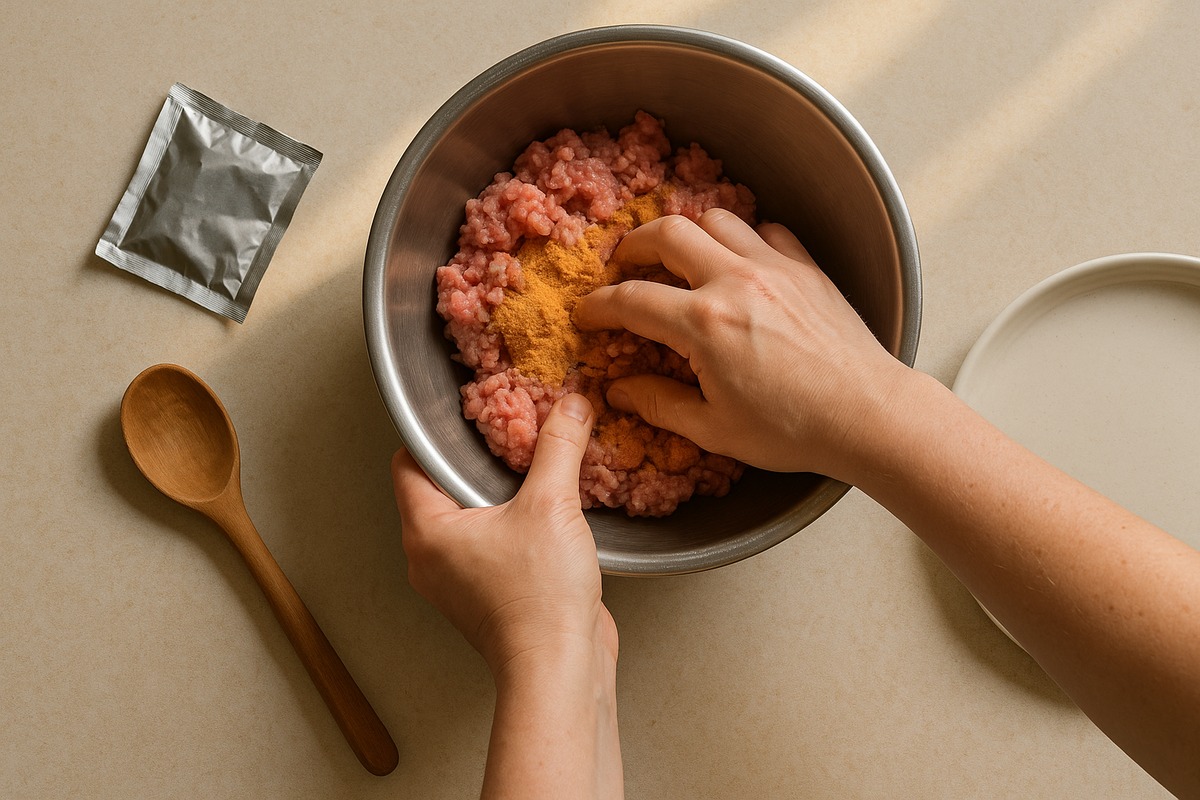
Here is what makes "Hikiniku ga Bakeru" genuinely different from the dozens of hamburger-steak seasoning mixes that have quietly existed on Japanese supermarket shelves for years: it requires nothing but ground meat. No onion. No breadcrumbs. No egg. No milk. You open one of six individually portioned pouches inside the box — each one calibrated to season about 150 grams of ground meat, roughly a single adult serving — knead it directly into the raw meat, shape it into an oval patty about a centimeter and a half thick, sear it in a pan for two minutes over medium-low heat, flip it, cover the pan, and let it steam-cook for another eight minutes. Total time: about fifteen minutes, roughly half of what the traditional version demands, and that fifteen minutes includes zero prep work beyond opening a foil pouch.
I tried it myself, because I did not believe a seasoning packet could replace the textural and flavor architecture that onion, breadcrumb, and egg provide in a traditional hamburger steak — each of those ingredients is doing real work, not just filler. The onion adds moisture and a faint sweetness as it caramelizes inside the patty. The panko-and-milk paste, called panko wo hitasu in Japanese kitchens, keeps the patty tender by interrupting the protein structure so it doesn’t compress into something dense and rubbery. The egg binds it all together so it doesn’t fall apart in the pan. Take all three away and, in theory, you should get a hockey puck.
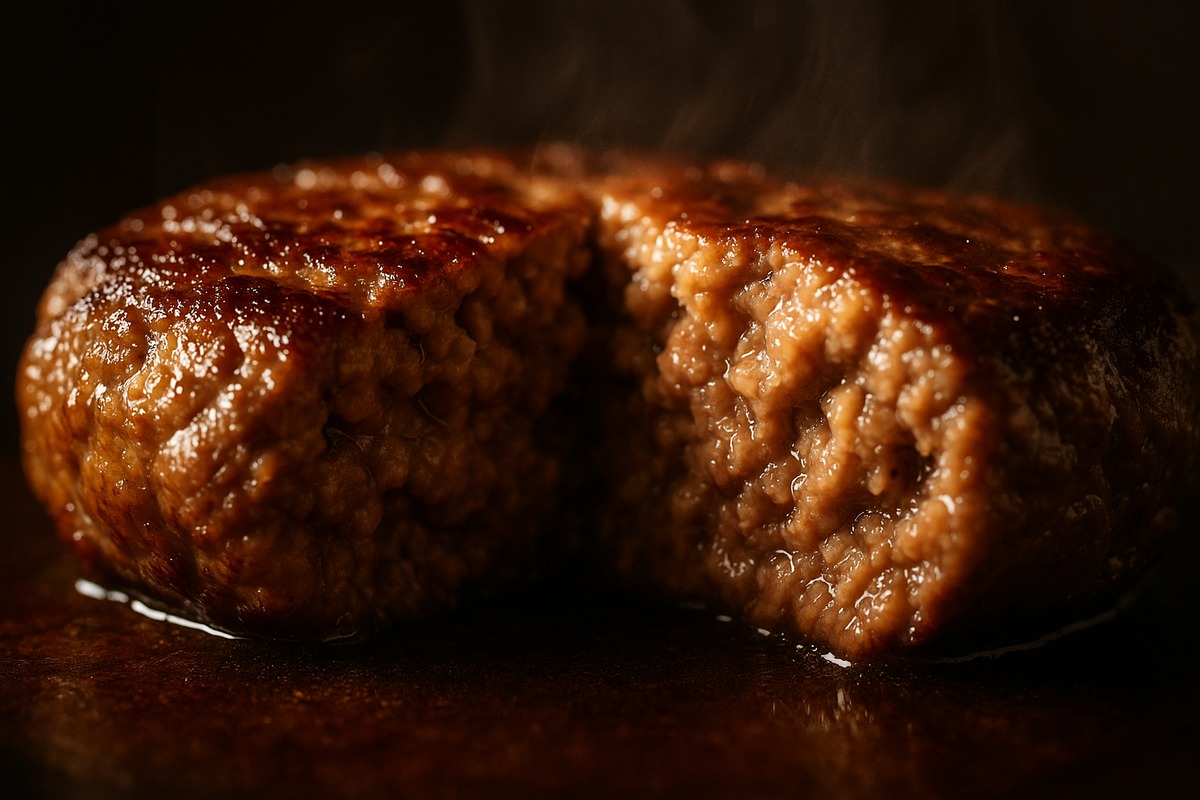
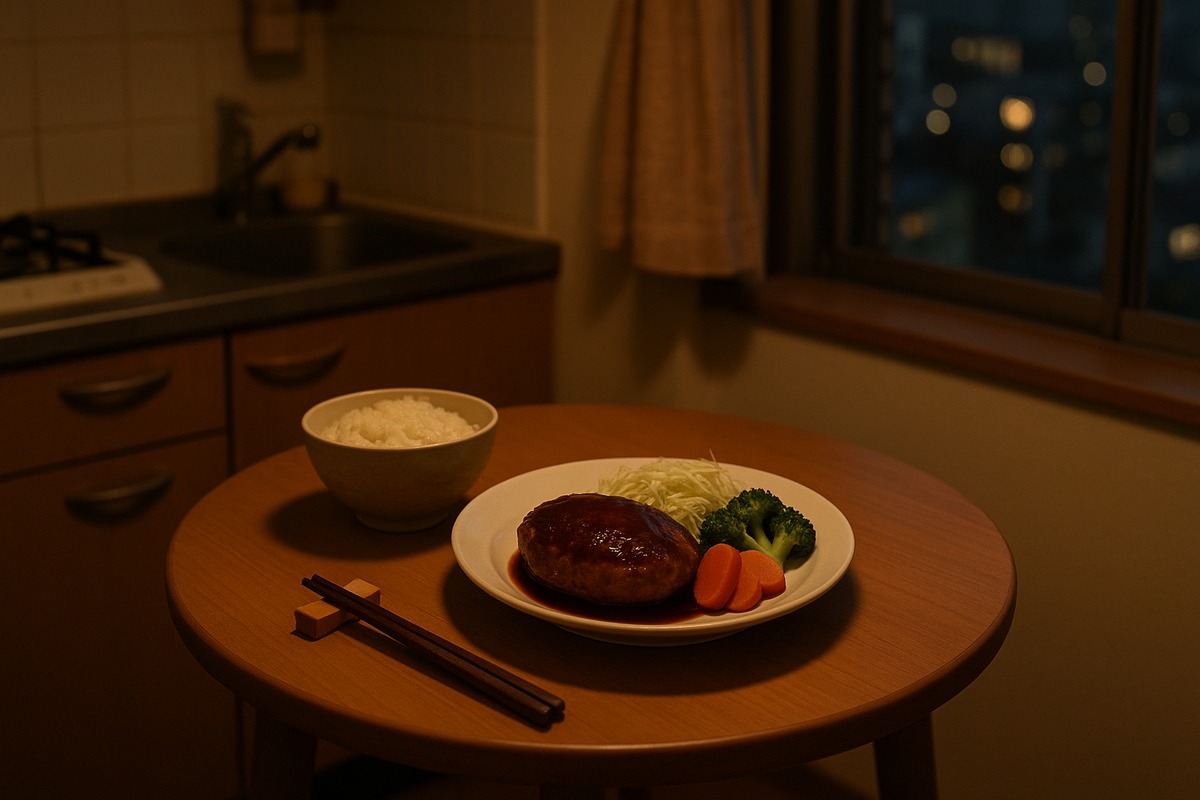
You do not get a hockey puck. What comes out of the pan is dense in a way that reads as "meaty" rather than "tough" — genuinely more like something from a steakhouse-adjacent hamburger-steak specialty restaurant than the fluffier, bread-cut version most Japanese households grew up on — and it is aggressively juicy, juicy enough that cutting into it releases a small pool of clear, well-seasoned fat and juice across the plate. The flavor is deep enough that you do not need the demi-glace or ponzu sauce that traditionally comes standard with hamburger steak; more than a few reviewers, myself included, found that a raw egg yolk dropped on top was the only embellishment the dish needed, mostly for richness rather than flavor correction. It tastes, unmistakably, like something a restaurant kitchen developed and then figured out how to shrink into a foil pouch. As it turns out, that is close to the literal truth.
The Numbers That Made Ajinomoto’s Own Forecasters Look Conservative
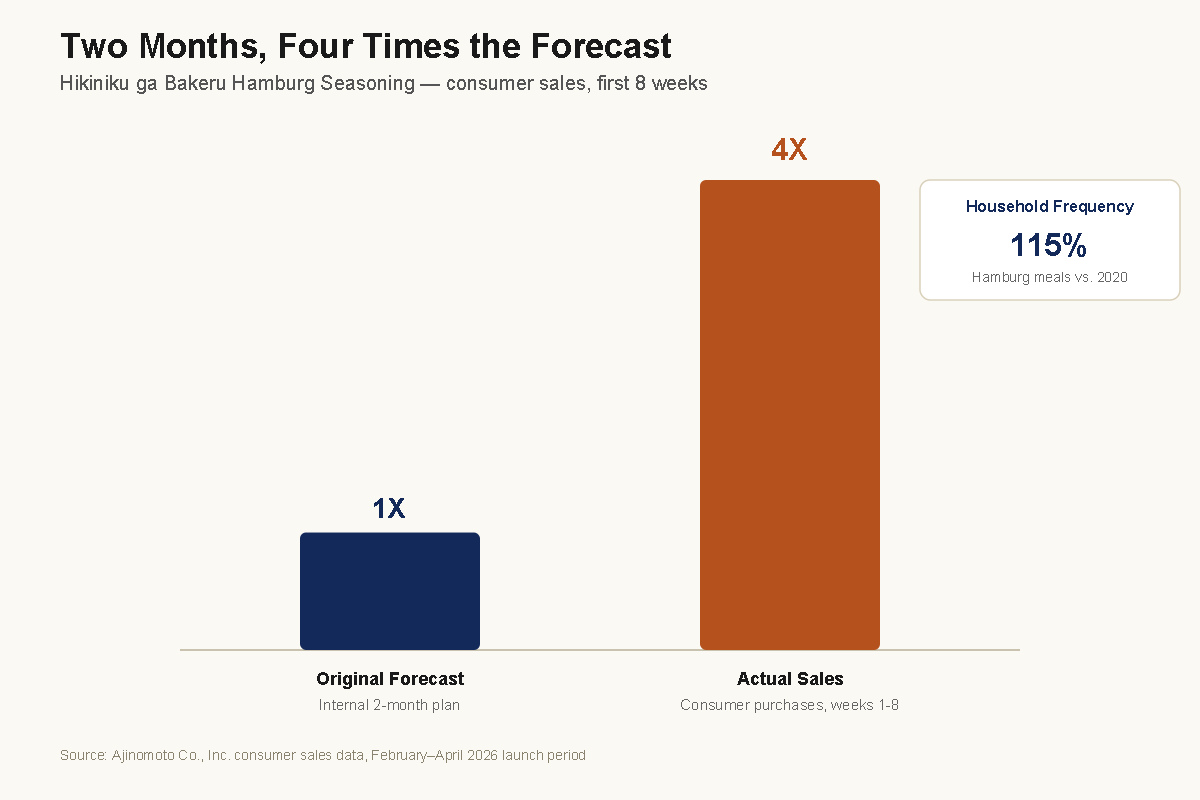
Consumer packaged goods companies build sales forecasts for a reason: launching a new SKU is expensive, and getting the number wrong in either direction creates real problems, either idle production capacity or empty shelves. Ajinomoto’s internal planning for "Hikiniku ga Bakeru" was not casual guesswork — it was informed by real category data showing that hamburger steak consumption frequency in Japanese households had already climbed to roughly 115% of 2020 levels, driven partly by a boom in "evolved hamburger steak" specialty restaurants whose recipes were being reverse-engineered and shared across Japanese social media, and partly by the relative price stability of ground meat compared with other proteins during a stretch of broader food inflation.
Even with that tailwind data in hand, the actual result blew past what the company had modeled. Within two months of the February 21, 2026 nationwide launch, consumer sales had reached roughly four times the original forecast, a performance strong enough that it landed the product on the radar of Japan’s food-industry trend-watchers as one of the more closely tracked new grocery items of the season — the kind of product analysts flag not because it is flashy, but because a mainstream ingredient conversion at this velocity, on a product this cheap, is unusual even in a category as large as hamburger steak. Ajinomoto’s full fiscal-year sales target for the product, measured at consumer purchase value, sits at roughly 100 million yen — a modest-sounding figure for a company of Ajinomoto’s scale, but a target that a two-month run at 4X pace suggests the company may need to revisit upward before the year is out.
What makes that acceleration notable from a B2B food-manufacturing perspective is where the growth is coming from. This is not a product winning share by being cheaper than its competitors on a like-for-like basis — plenty of hamburger-steak seasoning mixes on Japanese shelves cost less. It is winning by removing four separate shopping-list items and roughly twenty minutes of prep labor from a dish that most households already cook regularly, at a price point low enough that trying it carries almost no financial risk. That combination — habitual category, meaningful labor removal, near-zero trial cost — is a fairly rare alignment, and it is worth remembering the next time you are evaluating whether a new SKU idea is a genuine convenience innovation or just a marginally repackaged version of something that already exists.
The Food Science Behind "Ground Meat Alone"
The part of this story that should interest anyone who works in food science more than the sales figures do is how Ajinomoto pulled off a seasoning-only formula that replaces three structural ingredients, not just a flavor profile. According to the company’s own product materials, the seasoning draws on what it describes as decades of ground-meat menu know-how developed for Japan’s foodservice and restaurant supply business — the industrial side of Ajinomoto that supplies seasoning systems to restaurant chains, not the retail side most consumers interact with — reworked into a patent-pending formulation designed specifically for home cooks working with nothing but raw ground meat and a frying pan.
That lineage matters, because restaurant-supply seasoning technology is typically engineered to solve exactly the problem that shows up when you strip filler ingredients out of a ground-meat dish: without breadcrumbs interrupting the protein matrix, ground meat proteins can bind too tightly under heat, squeezing out moisture and producing a dense, dry result. Ajinomoto’s own explanation of the product leans on amino-acid science to describe how the seasoning encourages what the company calls a "meat-particle" sensation — distinct, juicy strands of meat rather than a uniform paste — while still holding the patty together without an egg. If that framing sounds familiar, it should: Ajinomoto is, at its core, a glutamate and amino-acid science company before it is a grocery brand. The company’s namesake product, AJI-NO-MOTO® umami seasoning, commercialized the discovery of monosodium glutamate as a standalone flavor compound back in 1909, and everything the company has built since — from industrial food-service seasoning systems to consumer snack coatings to, now, a hamburger-steak fix — traces back to that same amino-acid research lineage. Watching a century-old umami-science company apply that expertise to a structural cooking problem, rather than just a flavor problem, is a genuinely interesting case study in how deep, patient R&D in one narrow scientific domain keeps generating new commercial applications decades after the original discovery.
For food scientists and product developers outside Japan, the transferable lesson is less about hamburger steak specifically and more about the pattern: a company’s most valuable retail innovations are frequently downstream of B2B or foodservice technology that already exists inside the building, waiting for someone to reformulate it for a home kitchen. Ajinomoto did not invent new amino-acid chemistry for this launch. It took chemistry it had already proven at restaurant scale and re-engineered the delivery format for a very different customer — someone standing at a home stove with fifteen minutes and no sous chef.
What’s Actually in the Packet
Peel open one of the six individual pouches and the ingredient list reads like a fairly conventional Japanese pantry staple, not a laboratory formulation: wheat flour, sugar, powdered miso — two different varieties, according to the company, which is doing more flavor-layering work than a single miso type would — powdered soy sauce, ginger powder, garlic powder, and a blend of additional spices the company has not fully disclosed. The allergen declaration lists wheat, dairy, and soy, which tells you the powdered miso and soy sauce components are carrying real weight in both umami depth and, likely, some of the moisture-and-binding function that the missing egg and breadcrumbs would otherwise provide.
Nutritionally, each single-serving pouch comes in at a modest 55 kilocalories and 1.8 grams of sodium — numbers that matter because they are calculated to season the meat, not to replace a meaningful portion of it, which keeps the overall calorie and sodium profile of the finished dish close to what a home cook would get from seasoning ground meat with salt, pepper, and a splash of soy sauce by hand. The box itself weighs a mere 92.4 grams total across all six pouches and carries a 25-month shelf life, which is long enough to sit in a pantry through multiple restocking cycles without becoming a use-it-or-lose-it purchase — an important detail for a household that might not cook hamburger steak every single week but wants the option available without a special grocery trip.
The packaging format itself is arguably as important as the formulation. Six individually sealed pouches inside one box means the product scales cleanly from a solo diner making one patty on a Tuesday night to a family of four cooking the whole box at once, with no measuring, no eyeballing proportions, and no half-used bag of seasoning going stale in a cupboard between uses. That is a small design choice, but it is the kind of small design choice that shows up repeatedly in Japanese packaged-food innovation, where household sizes have been shrinking for years and single-portion formats have become a genuine competitive advantage rather than a niche accommodation.
Why This Is Landing Now: Cost-Consciousness Meets Time-Poverty
None of this happens in a vacuum, and the timing is not an accident. Japan has spent the past several years working through a stretch of food-price inflation unusual for a country that had gone decades with essentially flat consumer prices, and household budgets have responded the way household budgets everywhere respond to sustained inflation: with sharper attention to price per meal and a documented preference shift toward private-label and value-positioned grocery items. At the same time, Japan’s labor market has continued its long march toward dual-income households and longer average commute times, both of which compress the amount of discretionary evening time available for a from-scratch dinner.
Japanese food-trend forecasters have been circling a term for this convergence heading into 2026 — something close to "effort-cancellation," the idea that AI tools, convenience-engineered food, and labor-saving kitchen products are collectively normalizing the notion that removing effort from a task is not laziness but simple optimization, provided the outcome quality does not suffer. "Hikiniku ga Bakeru" fits that framing almost too neatly: it does not ask a cost-conscious household to trade down to a worse dinner, and it does not ask a time-poor household to accept a shortcut that tastes like one. It asks for 246 yen and fifteen minutes and delivers something that, by most home cooks’ own accounts, tastes like it came from a restaurant kitchen that actually knows what it is doing with ground beef and pork.
That price point deserves its own moment of attention, because 246 yen is a genuinely disarming number. It is cheap enough that a skeptical shopper — the exact kind of shopper I was, standing in a Tokyo supermarket aisle wondering whether a seasoning packet could really replace an egg and a cup of soaked breadcrumbs — has almost no reason not to try it once. Low trial friction paired with a product that actually delivers on its promise is precisely the mechanism behind viral, word-of-mouth grocery hits, and it is a far more reliable growth engine than advertising spend for a category as habitual and trust-dependent as home cooking.
There is also a solo-economy angle worth flagging for anyone tracking Japan’s demographic shifts. Japan has one of the highest single-person-household rates among developed economies, and that population has historically been underserved by recipes and packaged products designed around family-sized batches. A seasoning system built around individually portioned, single-serving pouches is a small but telling signal of how seriously Japanese food manufacturers are now designing for a household of one as a primary customer, not an afterthought.
What Food Manufacturers Outside Japan Should Take From This
If you make, market, or invest in packaged food or consumer seasonings anywhere in the world, three things about this launch are worth carrying with you beyond the specifics of hamburger steak.
The first is the underlying product architecture: a seasoning-format product that replaces structural ingredients, not just flavor. Most seasoning innovation in Western grocery categories focuses on flavor differentiation — a new spice blend, a regional flavor profile, a health claim like reduced sodium. "Hikiniku ga Bakeru" is doing something structurally more ambitious: using seasoning chemistry to substitute for binding and moisture-retention functions that home cooks traditionally solved with separate ingredients. That is a genuinely underexplored space in categories like meatballs, meatloaf, veggie burgers, and sausage patties outside Japan, and it suggests real headroom for seasoning companies willing to invest in the food-science side of the problem rather than the flavor side alone.
The second is the packaging lesson: individually portioned, single-use pouches inside a multi-serving box are a format that scales cleanly across household sizes without asking the customer to measure anything, and that format is still underused in Western grocery aisles outside a handful of categories like instant soup and salad dressing packets. Given how consistently shrinking household size shows up as a theme across developed markets, not just Japan, this packaging pattern is likely to keep showing up as a competitive differentiator wherever it gets applied thoughtfully.
The third is about where genuinely differentiated retail innovation tends to come from inside large food companies: not from a blank-sheet flavor lab, but from technology transfer out of a foodservice or B2B division that already solved a related problem at commercial scale. If your company has a foodservice, restaurant-supply, or industrial ingredients arm sitting alongside its consumer retail business, this launch is a useful prompt to ask what proprietary formulations are sitting in that division, unexploited, that could be reformulated for a home kitchen the way Ajinomoto reformulated decades of restaurant ground-meat seasoning science into a fifteen-minute, ground-meat-only hamburger steak.
Frequently Asked Questions
Q. Where can I buy "Hikiniku ga Bakeru" Hamburg Seasoning in Japan?
A. It is stocked nationwide in Japanese supermarkets, drugstores with grocery sections, and general merchandise chains, typically shelved alongside other hamburger-steak and meat-seasoning mixes in the seasoning aisle rather than in a specialty section. It is also sold through major Japanese e-commerce platforms including Rakuten and Yahoo! Shopping.
Q. Is this specific product available outside Japan or on Amazon in the U.S.?
A. Not currently. "Hikiniku ga Bakeru" is a Japan-domestic retail product with no confirmed U.S. distribution or Amazon.com listing as of this writing. The closest way to experience the same underlying umami science from the same company is Ajinomoto’s original AJI-NO-MOTO® umami seasoning, which is sold in the U.S. and is the foundational glutamate product from which the company’s century of amino-acid research, including this hamburger seasoning, ultimately descends.
Q. How much does it cost, and is it actually cheaper than making hamburger steak from scratch?
A. The retail price is roughly 246 yen (about $1.50) for a box of six individually portioned pouches, each seasoning about 150 grams of ground meat. Compared with buying an onion, breadcrumbs, milk, and eggs separately, it is close to cost-neutral on ingredients alone, but it saves roughly twenty to thirty minutes of prep labor per meal, which is the actual value proposition rather than raw grocery-bill savings.
Q. Why did this product outperform its own sales forecast so dramatically?
A. Ajinomoto had modeled growth based on rising hamburger-steak consumption frequency in Japanese households, but the combination of a genuinely low trial-cost price point, a real reduction in prep labor, and word-of-mouth from home cooks who found the taste and texture convincing appears to have driven adoption well beyond what that category data alone predicted — a pattern common to products that solve a habitual, high-frequency cooking task rather than a niche one.
Q. Does removing the onion, egg, and breadcrumbs change the nutritional profile of the finished dish?
A. Somewhat. Traditional hamburger steak recipes get some bulk and moisture from those additional ingredients, so a version made purely from seasoned ground meat will generally be higher in protein density and lower in carbohydrate content per patty, though the exact difference depends on the specific recipe being replaced and the ratio of meat used.
The Real Story Isn’t the Hamburger Steak
Strip away the ground beef and pork, and what is left is a case study in a very specific kind of corporate patience: a company sitting on decades of proprietary restaurant seasoning science, waiting for the right consumer moment — cost-conscious enough to reward a genuinely cheap product, time-poor enough to reward a genuinely fast one — to reformulate that science for a home kitchen. Ajinomoto did not invent a new flavor. It solved a structural cooking problem with chemistry it had already proven at commercial scale, priced the solution low enough that trying it required no real commitment, and let a habitual, high-frequency dinner do the rest of the marketing through word of mouth.
That is a more durable playbook than chasing a viral flavor trend, and it is exactly the kind of signal worth tracking if you are trying to read where Japan’s food industry — long a useful leading indicator for premium-convenience trends that eventually surface in other developed markets — is putting its R&D dollars next.
This article contains affiliate links. If you purchase through these links, we may earn a small commission at no extra cost to you.
If you’re interested in this topic, the Japanese market more broadly, or what KETCHUPs is working on, we’d love to hear from you — please reach out via our contact form.
Japan Market Pulse is a weekly read on what the Japanese consumer-tech, food, and mobility markets are choosing to do, written for international operators who want to know what is happening before it shows up in the global trade press.
Subscribe at ketchups.co/japan-market-pulse.