

This article is published by KETCHUPs, a Tokyo-based trading and brand-development firm. All content is editorial.
Japan isn’t just building flying taxis. It’s assembling the infrastructure, regulatory framework, and manufacturing ecosystem that makes them viable as daily business tools — and the 2027–2028 commercial launch window is closer than the international press has registered.
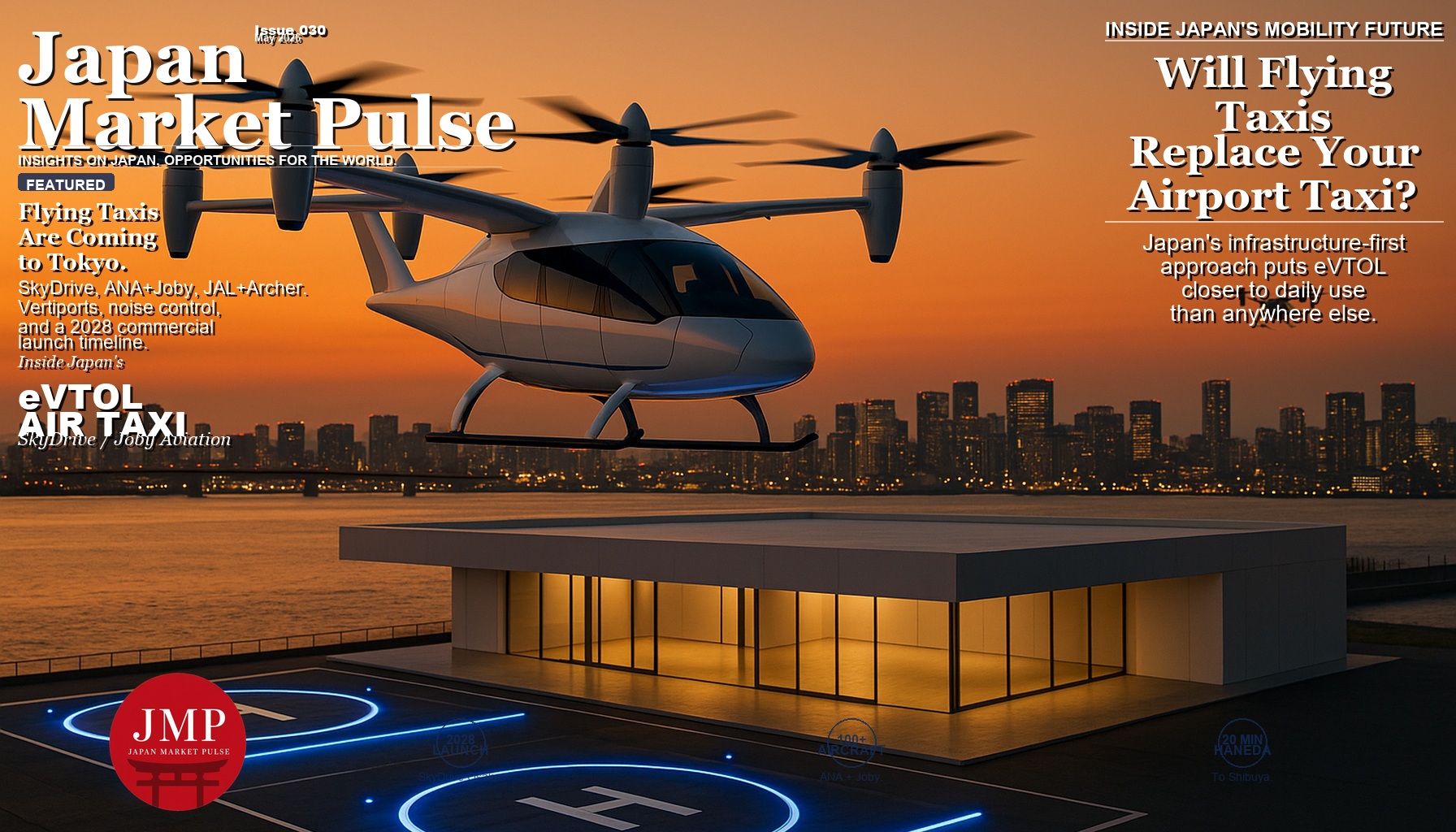
There is a moment, early on a spring morning in Osaka, where the sound arrives before the craft does. A low electric hum, nothing like the mechanical chop of a helicopter. Then a sleek white aircraft — sixteen rotors spinning in counter-rotating pairs — descends steadily toward a purpose-built landing pad on the waterfront. It touches down, powers off, and thirty seconds later it is rising again, banked northeast over Osaka Bay.
This wasn’t science fiction. It was April 2025, and SkyDrive’s SD-05 had just completed a public demonstration flight at the Osaka Expo Media Day. By the time international visitors arrived at Expo 2025 Osaka Kansai in the months that followed, Joby Aviation had joined SkyDrive in the sky above the exhibition grounds — their S4 aircraft banking silently over the crowds in a demonstration that Japan was serious about this technology in a way the world had not yet fully registered.
But if you paid attention only to the demonstrations, you’d miss the real story. The flights at Expo 2025 were not a preview of something distant. They were the visible tip of an infrastructure strategy that Japan has been quietly assembling for years — one that sets it apart from the United States, Europe, and virtually every other major economy pursuing electric vertical takeoff and landing aircraft, commonly known as eVTOL.
What Japan is building isn’t just a fleet of flying taxis. It’s the physical and regulatory ecosystem that makes them viable as a daily business tool. And if you’re involved in transportation, logistics, business travel, or real estate — this is worth understanding before 2028, when the first commercial routes are expected to launch.
The Day Osaka Declared Japan’s Aerial Commute Open for Business
The Expo 2025 site on Yumeshima island in Osaka Bay was designed, in part, to showcase Japan’s technology ambitions. But for eVTOL developers, it served as something more consequential: a proof of concept in one of the world’s most demanding operating environments.
On March 28, 2025, ORIX Corporation opened what it described as the world’s first multi-aircraft vertiport — the OSAKAKO Vertiport. Unlike the single-pad landing zones that have characterized eVTOL demonstrations elsewhere, this facility was built to handle concurrent aircraft operations, with dedicated ground crew, passenger waiting areas, and integrated connectivity to the surrounding transit network.
SkyDrive’s SD-05 and Joby Aviation’s S4 both operated at the Expo over the months that followed. By September 2025, public demonstration flights were running on a regular schedule, with passengers aboard for some segments. Engineers from Toyota, Honda, and Suzuki were watching closely. So were officials from the Ministry of Land, Infrastructure, Transport and Tourism.
This was not theater. Japan had spent the better part of three years building the administrative architecture that would allow this moment to happen, and the Expo was the first large-scale test of whether the pieces fit together. They did.
Meet the Companies Racing to Own Japan’s Sky
Understanding Japan’s eVTOL landscape requires knowing the players — because unlike the US market, where a handful of well-funded startups are competing mostly on aircraft design and FAA certification, Japan’s market is being built through partnerships between airlines, manufacturers, real estate firms, and government agencies.
SkyDrive is the most prominent Japanese-origin eVTOL company. Founded in 2018 and headquartered in Toyota City, Aichi, SkyDrive has developed the SD-05 — a three-seat aircraft capable of 100 km/h cruise speed with a range of 15 to 40 kilometers. The aircraft uses eight counter-rotating propellers in four pairs, a configuration that reduces noise compared to conventional rotorcraft and provides redundancy against rotor failure.
In 2024, SkyDrive formalized a manufacturing partnership with Suzuki Motor Corporation, giving it access to an annual production capacity of 100 aircraft. This is significant: most eVTOL companies globally are still in the prototype or early pre-production phase. Having a major automotive manufacturer as a production partner puts SkyDrive in a different category. On April 15, 2026, Japan’s Civil Aviation Bureau granted SkyDrive “Approved Design Organization” status — a formal certification milestone that puts the company firmly on the pathway to commercial launch. SkyDrive’s target: commercial air taxi operations in Osaka beginning in 2028.
ANA Holdings has taken a different approach, partnering with California-based Joby Aviation to introduce the Joby S4 into Japan. The S4 is a tilting-rotor design that cruises at up to 320 km/h — considerably faster than the SD-05 — with a range of around 160 km on a full charge. ANA and Joby have committed to introducing over 100 aircraft into Japan, with a shared goal of launching piloted air taxi services by 2027. In November 2025, the Tokyo Metropolitan Government formally selected both SkyDrive and Joby Aviation aircraft for Phase I of its eVTOL Implementation Project, lending official city endorsement to both programs simultaneously.
Japan Airlines has structured its eVTOL ambitions through Soracle, a joint venture with Sumitomo Corporation, which in turn has partnered with Archer Aviation — another California-based developer — for aircraft supply. Archer’s Midnight aircraft completed FAA-required testing in 2025 and is pursuing parallel certification in Japan.
Rounding out the picture, AirX — a Japanese charter aviation operator — signed a purchase agreement with Eve Air Mobility (a Embraer subsidiary) for up to 50 aircraft in February 2026, adding another aircraft type to the mix and another potential operator to the market.
The effect of this diversity is that Japan’s early commercial market will have at least four distinct aircraft types from four different developers competing for routes, passengers, and vertiport slots. That kind of early pluralism tends to accelerate price competition and service improvement in ways that monopolistic launch markets do not.
The Noise Problem — And Why Japan Is Closer to Solving It Than Anyone Else
Here is the paradox of flying taxis: they are quieter than helicopters, but the environments where they would be most useful — dense urban centers — are also the environments most sensitive to noise. Anyone who has lived near a hospital helicopter pad understands the problem. Even if an air taxi is quieter than a Bell 407, it doesn’t mean neighbors want to hear it fifty times a day.
Electric propulsion is inherently quieter than combustion power. An eVTOL’s motors, inverters, and battery system produce less overall sound energy than a piston or turbine engine, and the acoustic signature is different — higher in frequency, lower in intensity, and lacking the characteristic low-frequency “thump” of helicopter blades passing through disturbed air. That’s a meaningful advantage.
But noise engineers in Japan are going further. Researchers are developing deep-learning noise cancellation systems that work by analyzing real-time propeller RPM data alongside geolocation coordinates to predict the exact canceling sound wave needed to neutralize ground-level noise from specific approach paths. This is not active noise cancellation in the consumer electronics sense — it’s applied to the acoustic environment around vertiports, reducing the ambient sound impact on surrounding areas.
Joby’s S4 was specifically designed with urban operations in mind. The company’s engineers describe its acoustic profile as “minimal impact,” and flight tests have demonstrated it operating at sound levels comparable to conversational speech at 500 meters distance. For a vertiport located in central Tokyo or central Osaka, that matters enormously.
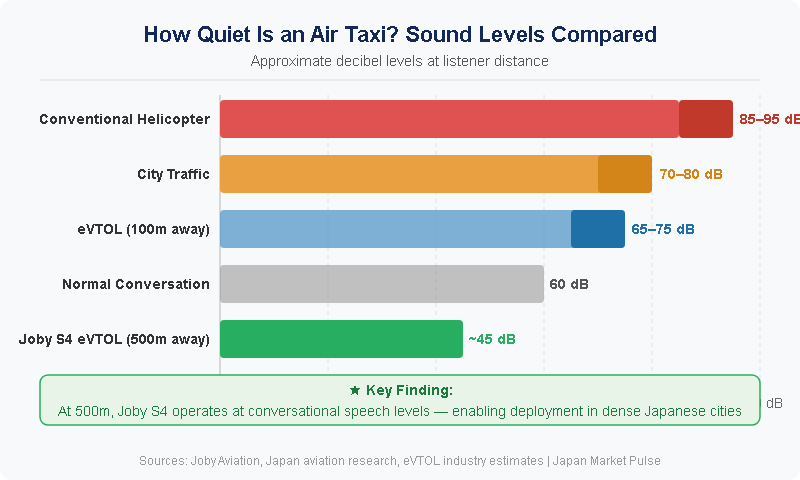
Japan’s urban density, often seen as a constraint, is actually functioning as an innovation pressure. Because the country simply cannot operate air taxis without solving the noise problem in genuinely dense residential and commercial areas, its developers and researchers are being pushed toward solutions that will prove useful everywhere else in the world once they’ve been validated here first.
The Vertiport Question: Where Will These Aircraft Actually Land?
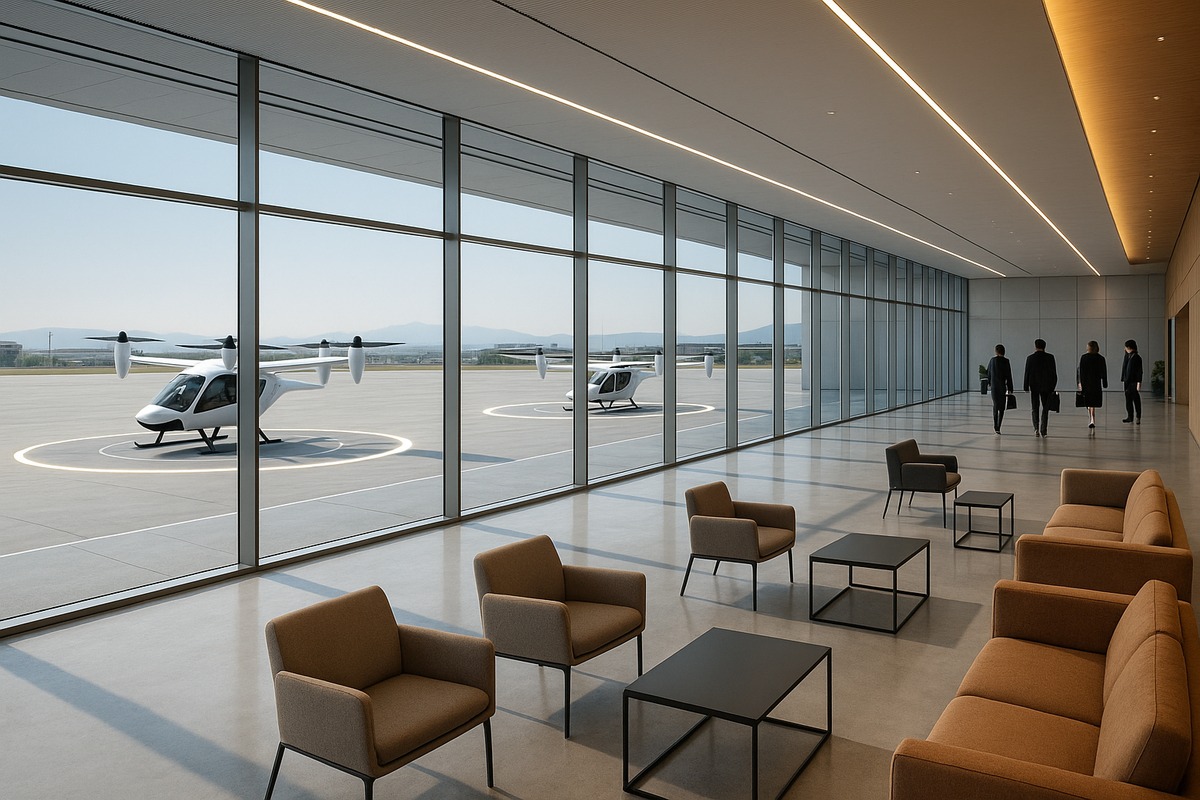
An eVTOL aircraft without a place to land is not a transportation system. It’s a prototype. This is why the vertiport question — where, how many, who builds them, who pays for them — is arguably as important as the aircraft question. And it’s where Japan’s strategy shows its most distinctive character.
Most countries currently treating eVTOL as a priority are working backward from the aircraft: certify the plane, then figure out where it lands. Japan is running the process in parallel, with MLIT having published formal vertiport design classifications — essentially a building code for landing infrastructure — that allows real estate developers and infrastructure firms to begin construction before specific aircraft operators are licensed.
SkyDrive has taken this further by entering discussions with Japanese highway service area operators about placing vertiports at highway rest stops along major national routes. The logic is elegant: highway service areas already have parking, amenities, power infrastructure, and — in Japan’s context — sophisticated management systems. Adding a vertiport to an existing service area is a smaller logistical challenge than building one from scratch, and highway rest stops are spaced at intervals that align well with eVTOL range for inter-city routes.
The OSAKAKO Vertiport, which ORIX operates on reclaimed land on Osaka Bay, is being used as a learning laboratory. ORIX has been studying dwell times, power management between flights, passenger flow, and ground crew workflows. The insights from this facility will shape the design of the next generation of vertiports.
There’s also a coordination play underway to connect vertiports to Japan’s existing transit infrastructure. Rather than competing with shinkansen or subway systems, Japan’s planners are designing vertiports to function as premium access points — a final connection from a distant airport to a transit node, or a high-speed link from a downtown helipad to a coastal resort that would otherwise require two hours of train travel. This is the air taxi as a gap-filler in an already excellent transit network, not as a replacement for it.
The Regulatory Playbook That Is Actually Working
Regulatory certainty is one of the most frequently cited barriers to eVTOL commercialization globally. In the United States, FAA certification pathways for novel aircraft categories have been slower and more uncertain than developers initially projected. In Europe, EASA has moved more decisively but vertiport regulations lag behind aircraft certification timelines.
Japan’s approach has been to treat eVTOL as a national infrastructure priority requiring coordinated action across multiple agencies simultaneously. MLIT established the “Air Mobility Revolution Roadmap” and the “Public-Private Council for Air Mobility Revolution” — a formal body bringing together government officials, airlines, municipalities, aircraft developers, and infrastructure operators around a shared planning framework.
The roadmap identifies four primary use cases for commercial eVTOL operations: secondary airport transportation (connecting smaller regional airports), intra- and inter-urban transit, entertainment and tourism, and emergency medical transport. Each use case has its own regulatory requirements, risk profile, and commercialization timeline. By segmenting the market this way, Japan avoids the trap of treating all eVTOL operations as the same regulatory challenge and can move faster on the lower-risk categories while higher-risk urban routes are still being certified.
SkyDrive’s April 2026 Approved Design Organization designation from the Civil Aviation Bureau is the most concrete recent evidence that this process is functioning. This certification means SkyDrive now operates under a quality management system recognized by the Japanese government — the same status held by major conventional aircraft manufacturers — and is formally positioned to work through the remaining airworthiness certification steps on a defined timeline.
Tokyo Metropolitan Government’s November 2025 selection of Phase I eVTOL implementation projects is equally important. By choosing specific aircraft and operators for initial trials within Tokyo, the metropolitan government has created a protected operating environment — essentially a sandbox — where real-world data can be gathered under regulatory supervision before full commercial launch.
What It Will Cost to Fly — and What the Price Path Looks Like
Current projections for air taxi pricing in Japan reflect the economics of early adoption: higher than most travelers will consider for routine use, but not dramatically out of reach for business travelers who currently pay premium fares for time.
The most commonly cited initial routes and their projected prices: Haneda Airport to Shibuya would be approximately ¥9,800 (roughly $67 USD), while Narita to central Tokyo’s Marunouchi business district would run around ¥18,000 (about $123). Compared to the ¥3,500 limousine bus or a ¥1,500 train ride, these prices are not competitive on value for everyday commuters. But against a premium taxi or an executive car service during peak congestion, they begin to look more interesting.
ANA and Joby have indicated they are targeting an initial price point of $200–270 per flight for early routes, aimed specifically at business travelers willing to pay for time savings. The reasoning is that a 20-minute flight from Haneda to a meeting in central Tokyo, compared to a 60 to 90-minute ground transit in traffic, represents a significant productivity exchange for anyone billing at professional rates.
The price path over time follows the classic scaling logic: as manufacturing volumes increase (SkyDrive’s Suzuki facility targets 100 units per year to begin), as vertiport infrastructure is amortized, and as pilots are replaced by autonomous systems on certain routes, unit economics improve and prices fall. Developers are targeting something closer to premium taxi pricing — perhaps ¥4,000 to ¥6,000 per short urban hop — within five to ten years of commercial launch. That’s the price point where daily business use becomes realistic for a significant segment of Tokyo’s professional population.
How Japan’s Approach Differs from the US and Europe
The United States has been the center of gravity for eVTOL investment globally, with Joby, Archer, Lilium, Volocopter, and a dozen other companies having raised billions of dollars. But American eVTOL development has followed a predominantly startup-driven model, with individual companies navigating FAA certification independently and vertiport infrastructure left largely to private real estate developers.
The result is that while the US has the world’s largest eVTOL investment base, it has relatively fragmented coordination between aircraft certification, infrastructure development, and operational planning. Several major US eVTOL developers have delayed their commercial launch timelines, some by multiple years, due to certification uncertainties.
Europe has moved more decisively on regulatory frameworks — EASA’s Special Condition for VTOL aircraft is more structured than FAA’s early approach — but has lagged on physical infrastructure. The EU’s Urban Air Mobility initiative has produced detailed planning documents, but actual vertiport construction has been slow.
Japan’s approach is distinguished by two things: state-led coordination that brings multiple stakeholders into alignment simultaneously, and a manufacturing ecosystem — anchored by companies like Toyota, Suzuki, and Honda — that treats eVTOL production as an extension of existing automotive and aerospace supply chains rather than a startup problem to be solved from scratch.
Japan’s cities also happen to be well-suited to short-hop air mobility in a way that US cities are not. Tokyo, Osaka, and other major Japanese urban centers have exceptional public transit coverage for medium-distance trips. The gap in Japan’s mobility system is precisely the 10 to 40 kilometer segment that eVTOL serves best — connecting airports to city centers, city centers to suburban hubs, and coastal cities to island destinations that are poorly served by surface transport.
What This Means for International Business Operators
If you run a business that involves regular travel to Japan — or if you work in logistics, hospitality, commercial real estate, or transportation — the 2027 to 2030 window is when eVTOL will begin to materially affect how you operate in the country.
The most immediate impact will be airport connectivity. The current ground transit from Narita to central Tokyo is genuinely painful — either a 60-minute express train or an 80 to 100-minute car ride in ordinary traffic. A Narita-to-Marunouchi air taxi running on a 25-minute schedule, operating from a vertiport at the arrivals level, would represent a different kind of arrival experience. Major business hotels in central Tokyo that secure vertiport access — even a single-pad facility on a rooftop — will have a genuine amenity advantage over those that don’t.
In logistics, the first commercial eVTOL operations are expected to include some premium cargo capacity — small packages, urgent pharmaceuticals, high-value electronics — where the speed premium justifies the cost. Companies that establish early relationships with eVTOL operators for time-critical shipments will develop operating knowledge that becomes a competitive advantage as the market scales.
For tourism and hospitality, the implications are larger still. Japan has extraordinary destinations — historical towns, coastal resorts, mountain areas — that are currently 2 to 4 hours from major cities by ground transport. Bringing those destinations within 30 to 40 minutes by air changes the economics of a short trip dramatically. Ryokan operators in Ise-Shima or the Kumano Coast who are positioned near vertiport infrastructure by 2028 will see a different customer profile than those who are not.
The 2025–2030 Timeline at a Glance
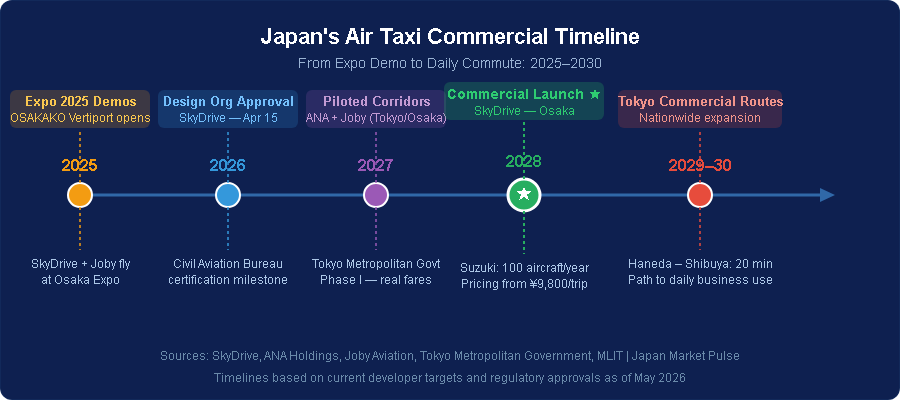
Japan’s eVTOL commercialization is not a single event but a sequence of escalating milestones, each building on the last.
In 2025, the Osaka Expo demonstrated that the technology works in a real-world public environment. ORIX opened the world’s first multi-aircraft vertiport. Regulatory frameworks were tested and refined. Public awareness was built through sustained media coverage.
In 2026, SkyDrive’s Approved Design Organization certification moved Japan’s leading domestic developer past a critical regulatory threshold. Manufacturing preparations at the Suzuki facility advanced.
By 2027, ANA and Joby are targeting piloted commercial corridor operations in Tokyo and Osaka — real aircraft, real passengers, real fares — under the Tokyo Metropolitan Government’s Phase I implementation framework. This will be the first year in which a business traveler in Japan can, at least experimentally, choose an eVTOL over a taxi or train.
In 2028, SkyDrive expects to launch commercial operations in Osaka, with Suzuki production at capacity. This is the year when the Expo-era demonstrations convert into a functioning market, however limited in scale.
From 2028 onward, the trajectory depends on how well the early operations perform — on noise, reliability, safety, and economics. If the data is good, Tokyo commercial routes follow in the 2029 to 2030 window, and the infrastructure buildout accelerates. If there are setbacks, Japan’s phased approach means the program doesn’t collapse — it adjusts.
The honest assessment is that Japan is further along this path than the headlines suggest, and the major milestones over the next three years will be worth watching closely.
Looking Up
When I think about the flying taxi story, I find myself thinking about Japan’s Shinkansen, which began service in 1964 in time for the Tokyo Olympics — a transportation technology that seemed audacious at the time and is now unremarkable infrastructure. Nobody boards the Tokaido Shinkansen and marvels. They check their phone.
That’s the endpoint Japan is building toward with eVTOL — not novelty, but routine. An aircraft that operates from a vertiport near Haneda with the same punctuality and predictability as a train. A 20-minute hop that gets you to a Kyoto meeting without the psychological weight of a long car journey.
It will not happen overnight. But the infrastructure strategy, the regulatory alignment, and the manufacturing partnerships that Japan has assembled over the past three years represent something more durable than hype. The country is not just building flying taxis. It is building the conditions under which flying taxis become unremarkable.
If you’re involved in business in Japan, or thinking about it, 2028 is a date worth putting in your calendar. Not because everything will be ready — it won’t be. But because that is when Japan will begin converting a decade of investment into something you can actually board.
If you’re interested in this topic, the Japanese market more broadly, or what KETCHUPs is working on, we’d love to hear from you — please reach out via our contact form.
Japan Market Pulse is a weekly read on what the Japanese consumer-tech, food, and mobility markets are choosing to do, written for international operators who want to know what is happening before it shows up in the global trade press.
Subscribe at ketchups.co/japan-market-pulse.