

Disclosure: This article is published by KETCHUPs, a Tokyo-based trading and brand-development firm. All content is editorial.
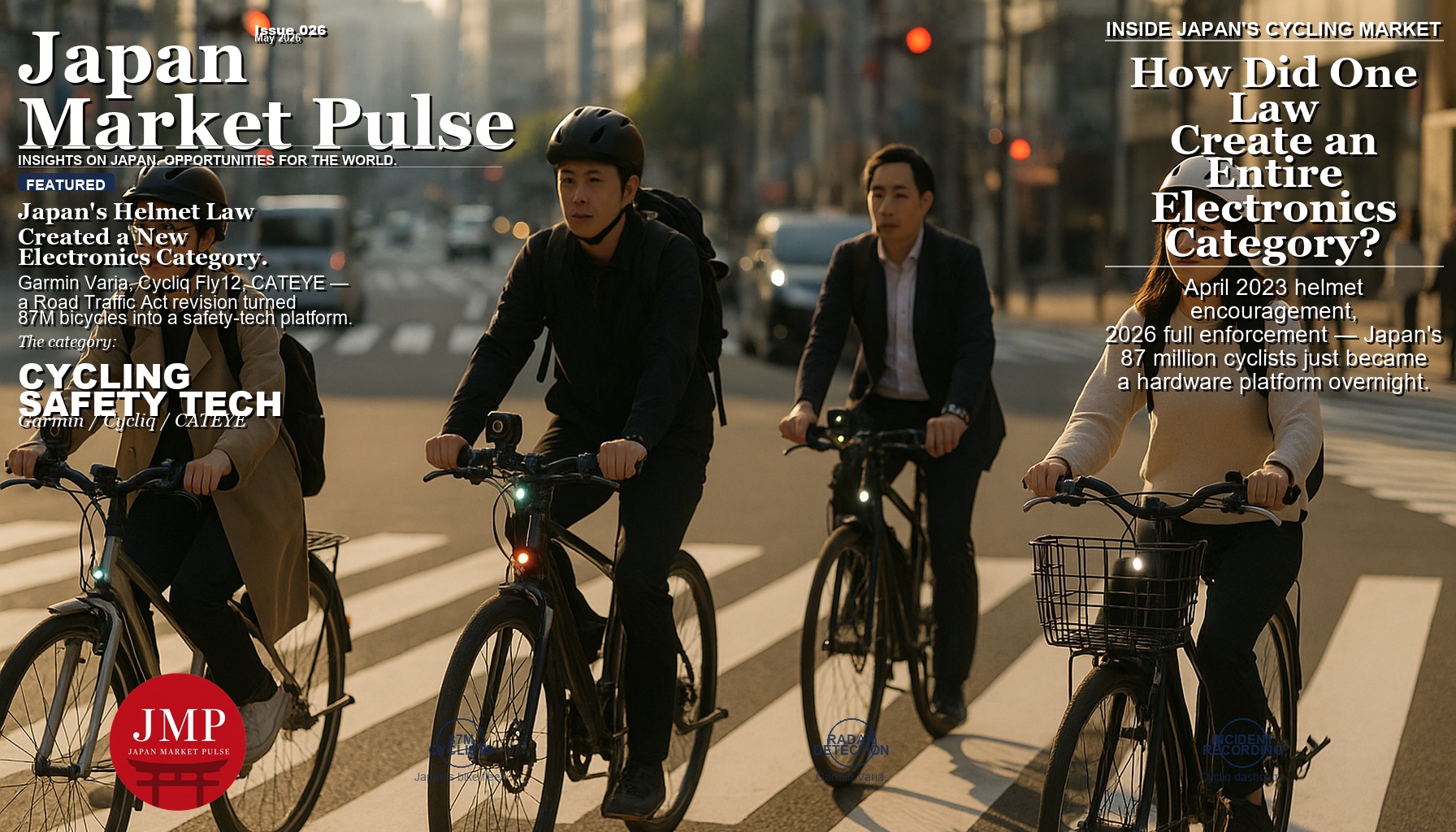
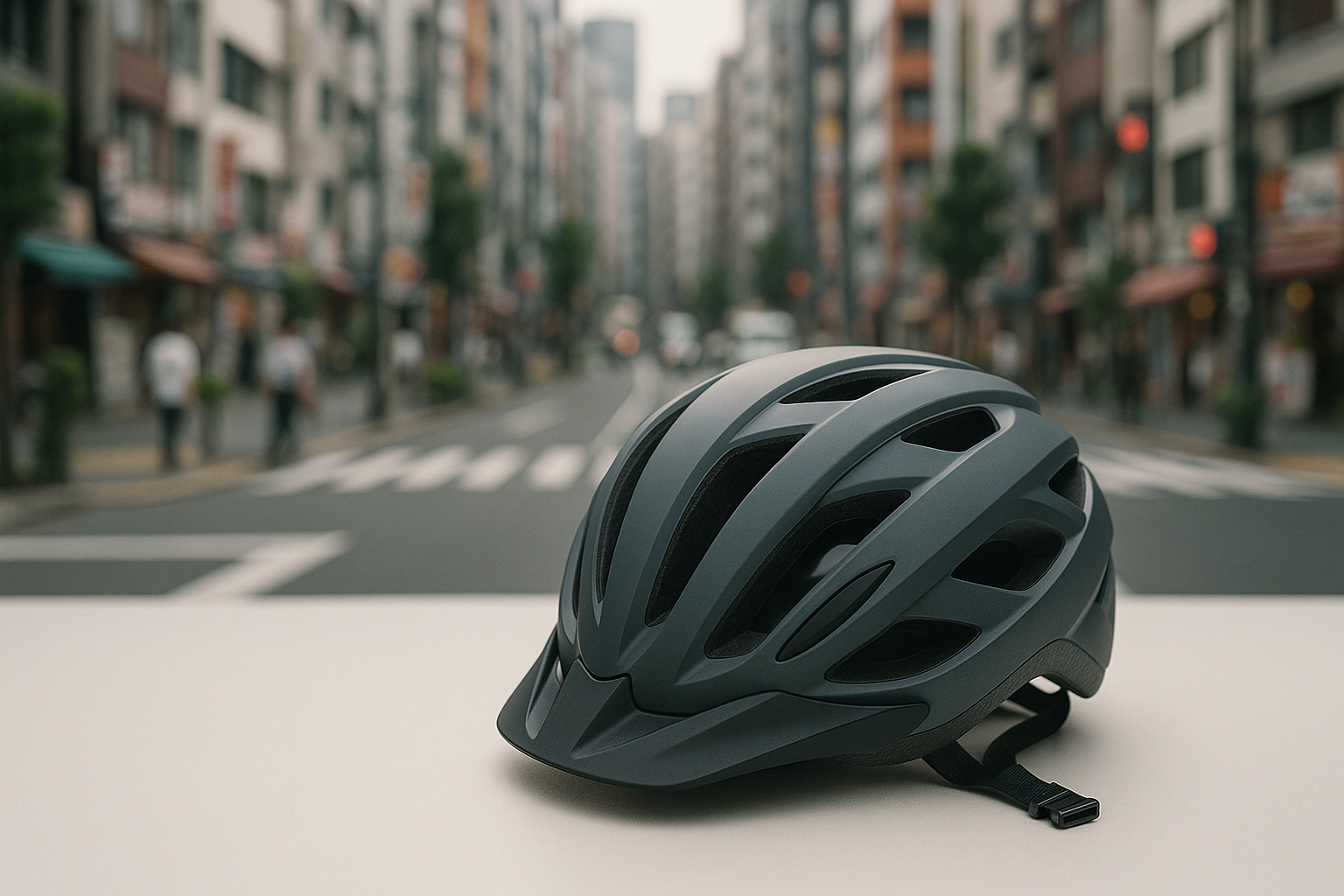
When Japan revised its Road Traffic Act in April 2023, making helmet use “strongly recommended” for all cyclists, the immediate market response was textbook: helmet sales spiked. Retailers ran out of stock. OGK Kabuto’s website went down. The story wrote itself, and most of the coverage stopped there.
What happened next is more interesting.
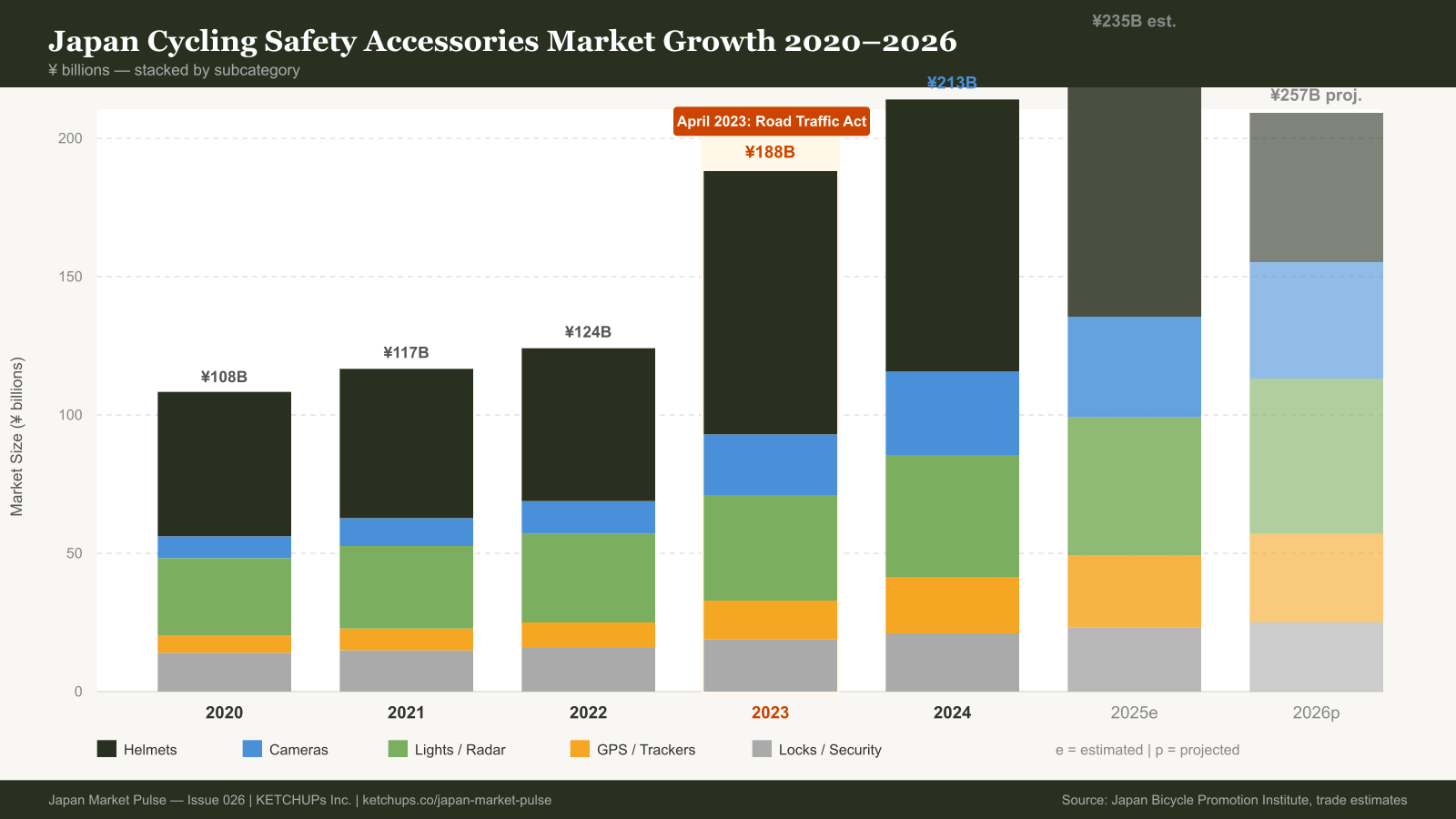
Over the following 18 months, Japan’s cycling accessories market underwent a category expansion that has no precise Western parallel. Cyclists who bought helmets — spurred by a combination of genuine safety concern, social pressure, and the psychological principle that a ¥5,000 helmet purchase unlocks willingness to spend on the surrounding ecosystem — began systematically upgrading their entire setup. Rear radar units. Front-facing dashcams. GPS trackers. Smart locks. Handlebar computers with integrated safety alerts. A market that had been stable at roughly ¥180 billion ($1.2 billion) annually saw its safety subcategory accelerate to 25% year-over-year growth through 2023 and 2024.
The Law That Wasn’t Quite a Law
The April 2023 revision to Japan’s Road Traffic Act occupies an interesting legal category. It does not fine cyclists who ride without helmets — enforcement would be practically impossible given the scale of daily cycling in Japan. What it does is establish a statutory duty of effort: a formal social expectation backed by law, carrying reputational rather than financial consequences.
For a market like Japan, this distinction matters less than it might in, say, the United States. Japanese consumer behavior research consistently shows that publicly codified norms function almost as hard requirements, particularly for behavior that is visible to others. Cycling on a public road without a helmet after April 2023 became, in the social calculus of Japanese urban life, a minor but meaningful signal of non-compliance with a stated community standard.
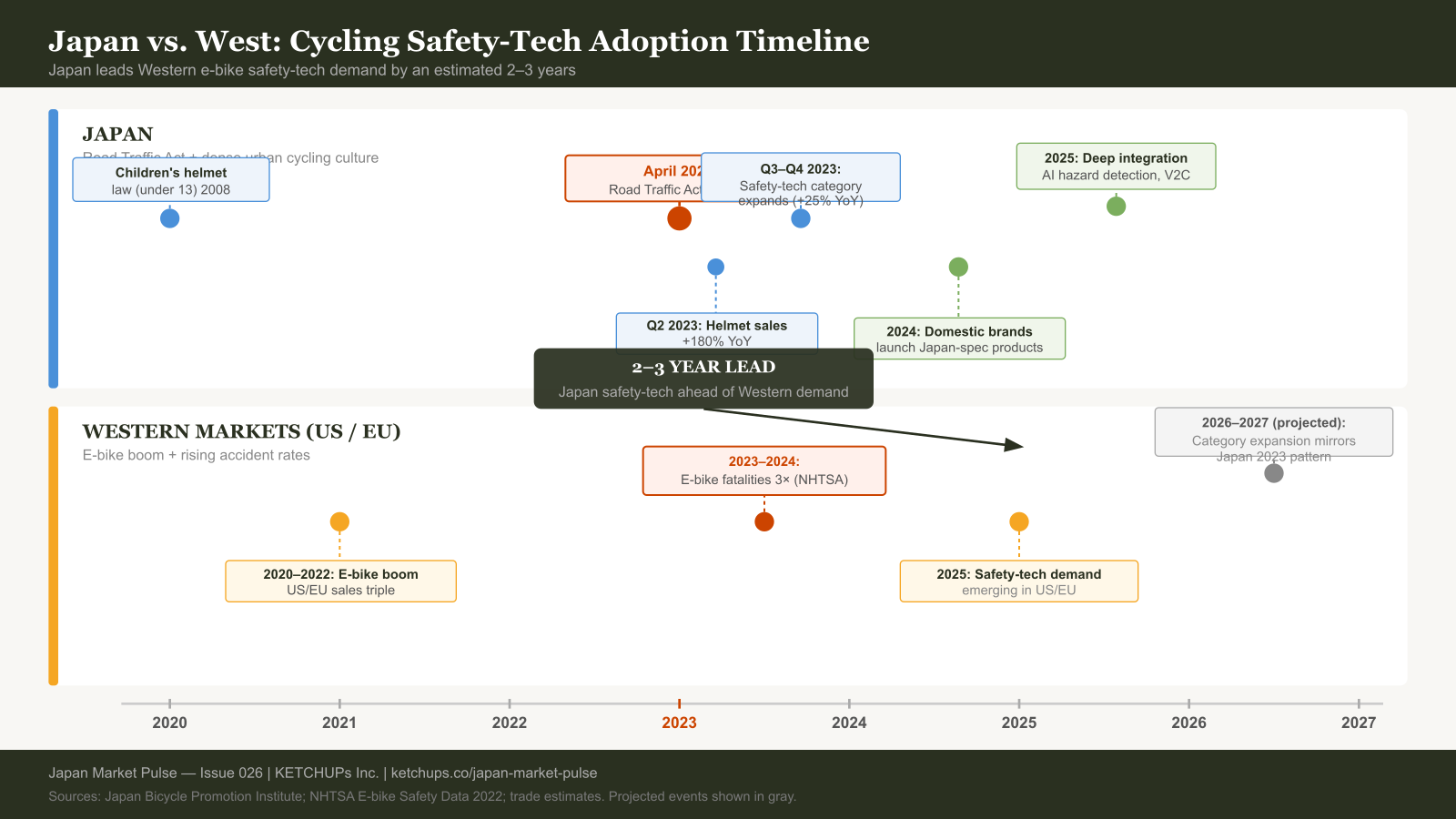
Japan Bicycle Promotion Institute data shows helmet sales increasing 180% in Q2 2023 compared to Q2 2022. That figure represents the visible first-order effect. The second-order effect — the safety-tech category expansion — took another quarter to fully manifest and has been less thoroughly documented in the English-language press.
87 Million Bicycles, and How They’re Actually Used
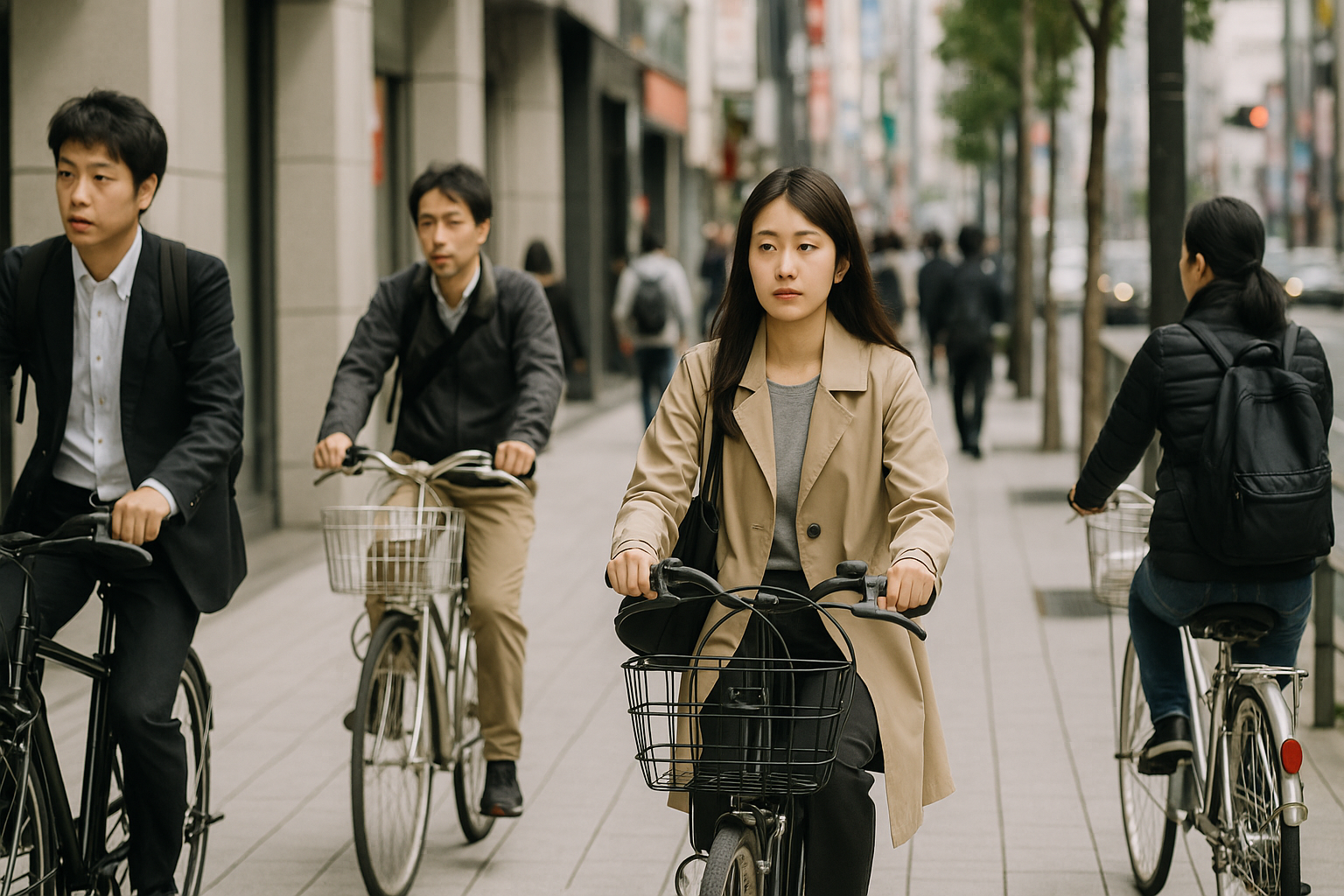
Japan has approximately 87 million registered bicycles. Tokyo alone sees an estimated 10 million bicycle trips per day. The overwhelming majority of this cycling is utilitarian — commuting, grocery runs, school transit — and it happens primarily on sidewalks and designated paths, not on roads. This creates product requirements that diverge sharply from the European or American cycling market.
Japanese cycling safety-tech products reflect this. The camera systems that gained traction post-2023 lean toward wider viewing angles than Western equivalents. The sensor products that performed well emphasize pedestrian detection over vehicle detection. Even the form factor of popular devices tilted toward smaller, lighter units less conspicuous on a commuter bicycle than on a racing setup.
The Products That Led the Wave
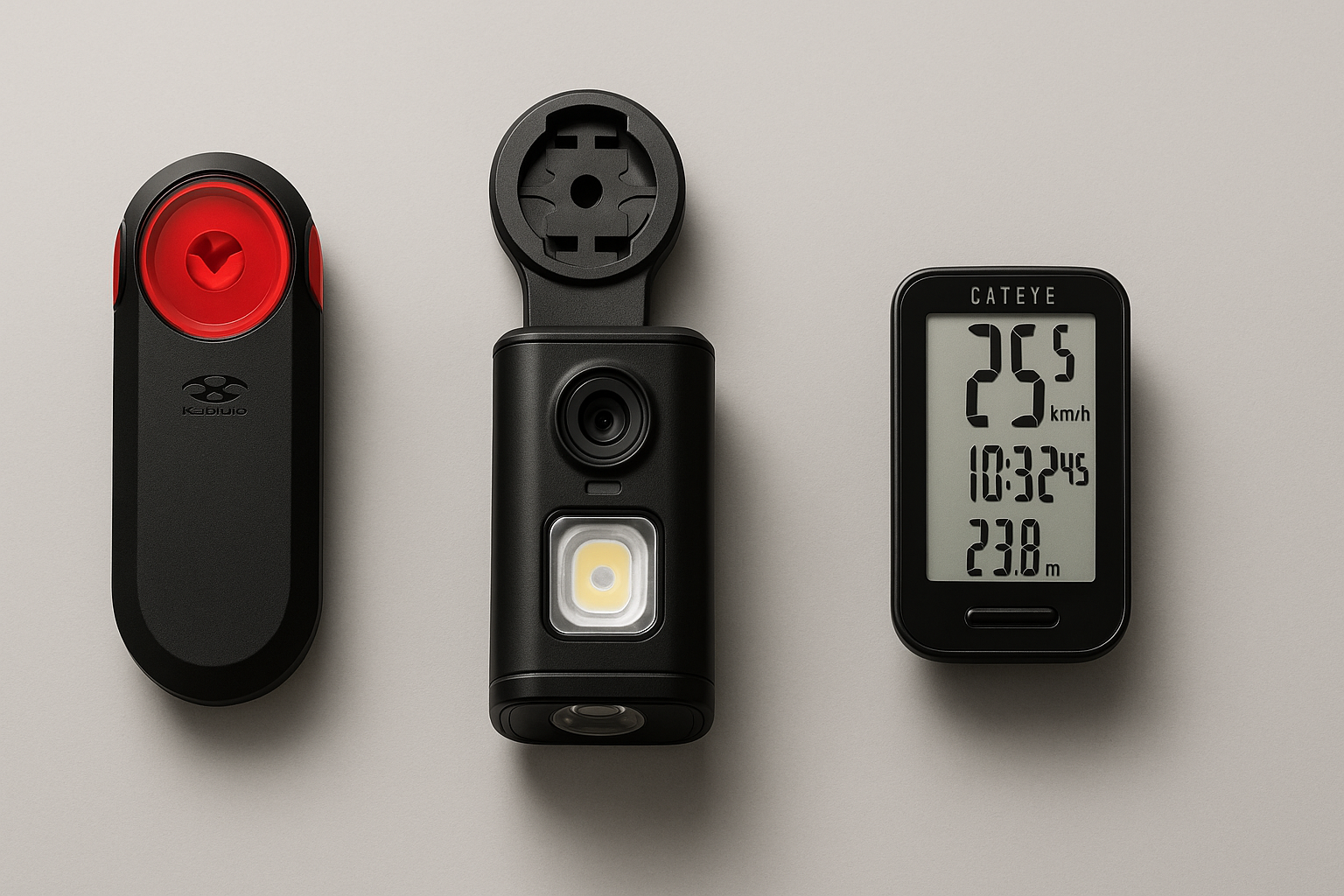
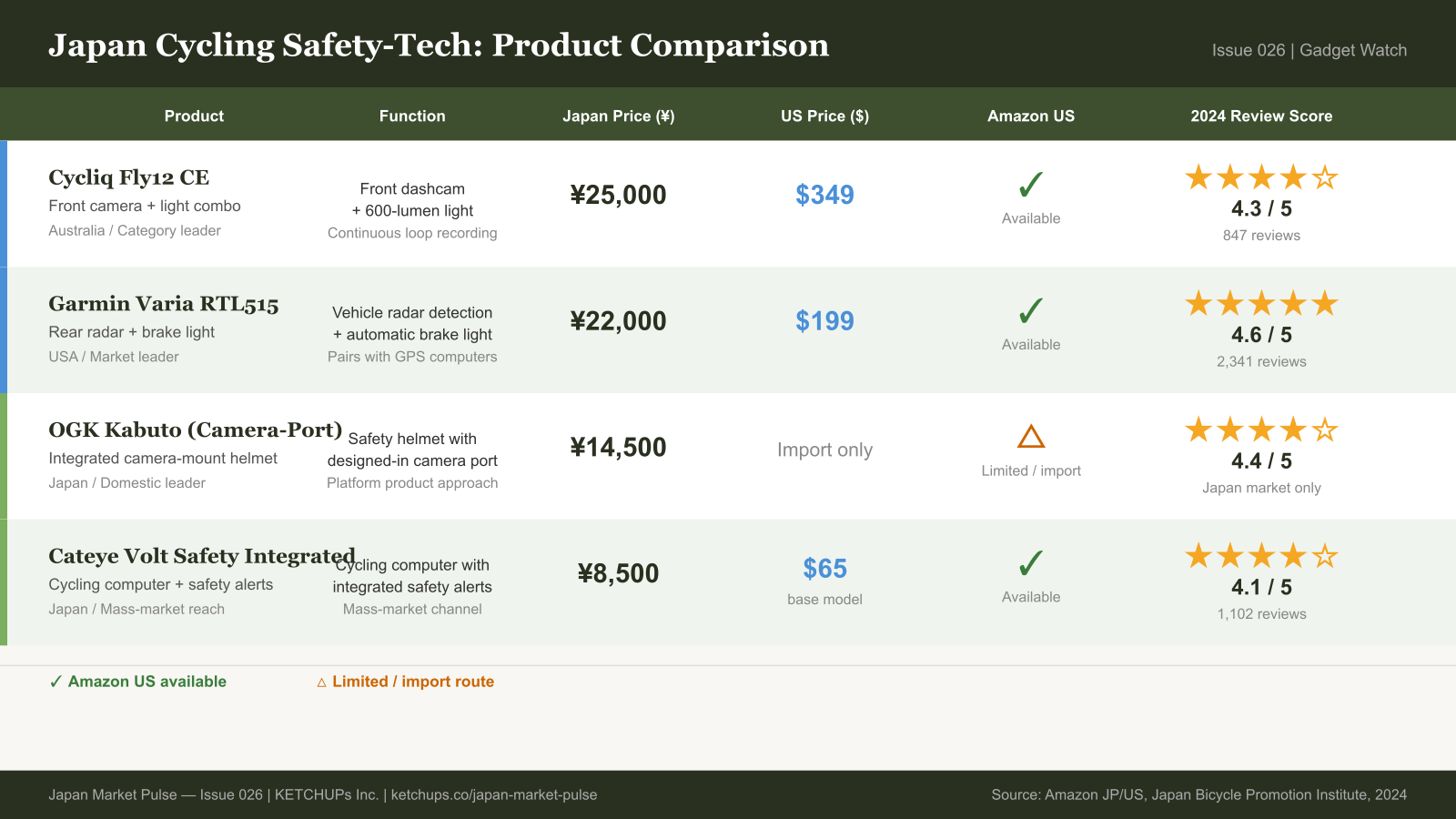
Three product categories dominated the first wave of post-law expansion: integrated camera-light systems, rear radar units, and GPS/tracking hardware. The Cycliq Fly12 CE became the unexpected category leader for front-mounted camera-light combos at roughly ¥25,000. The Garmin Varia RTL515 carved out the rear-facing radar segment at approximately ¥22,000 — retailing at $199 on Amazon US. Domestic Japanese brands adapted rather than competed directly: OGK Kabuto introduced a helmet line with an integrated camera mounting port, while Cateye expanded its cycling computer line to include safety-specific integrations through its existing mass-market retail network.
Pricing Architecture and the ¥22,000 Sweet Spot
One pattern that emerges consistently: the ¥20,000–¥25,000 price range captured disproportionate market share in the premium safety-tech segment. The Garmin Varia RTL515 at ¥22,000 and the Cycliq Fly12 at ¥25,000 both landed in this range. Products that struggled were either too cheap (¥3,000–¥5,000 safety lights that felt incremental) or too expensive (¥50,000+ cycling computers priced out of the commuter market). This pricing architecture has implications for Western brands looking at Japan entry: the ¥22,000 sweet spot corresponds to approximately $145–150, a price that Japanese consumers take seriously but don’t require multi-day research to justify.
Why the Category Expanded Rather Than Just Spiking
The 180% helmet sales increase in Q2 2023 was a spike. The sustained 25% growth in safety accessories through 2024 is a category expansion. Several structural factors explain why it didn’t revert: the helmet purchase created a “foot in the door” commitment mechanism; Japanese retail responded with curated safety bundles reducing cognitive load; and the social visibility of cycling safety equipment functions as ongoing peer demonstration in Tokyo’s dense cycling commuter population.
The Western Parallel and the Two-to-Three Year Gap
The United States and European markets are running a version of this story approximately two to three years behind Japan’s curve. The proximate driver is different — in the West, the catalyst is the e-bike boom rather than a specific regulation — but the structural dynamic is similar. E-bike accident rates in the US have risen sharply as adoption has accelerated. The products that would address this demand are largely already developed and refined by the Japanese market. For Western operators, Japanese cycling safety-tech is a reasonable proxy for what will be in demand in US and European markets within the next 24 to 36 months.
If you’re interested in this topic, the Japanese market more broadly, or what KETCHUPs is working on, we’d love to hear from you — please reach out via our contact form.
Japan Market Pulse is a weekly read on what the Japanese consumer-tech, lifestyle, and adult-collectibles markets are choosing to do, written for international operators who want to know what is happening before it shows up in the global trade press.
Subscribe at ketchups.co/japan-market-pulse.