

Disclosure: This article is published by KETCHUPs, a Tokyo-based trading and brand-development firm. All content is editorial.
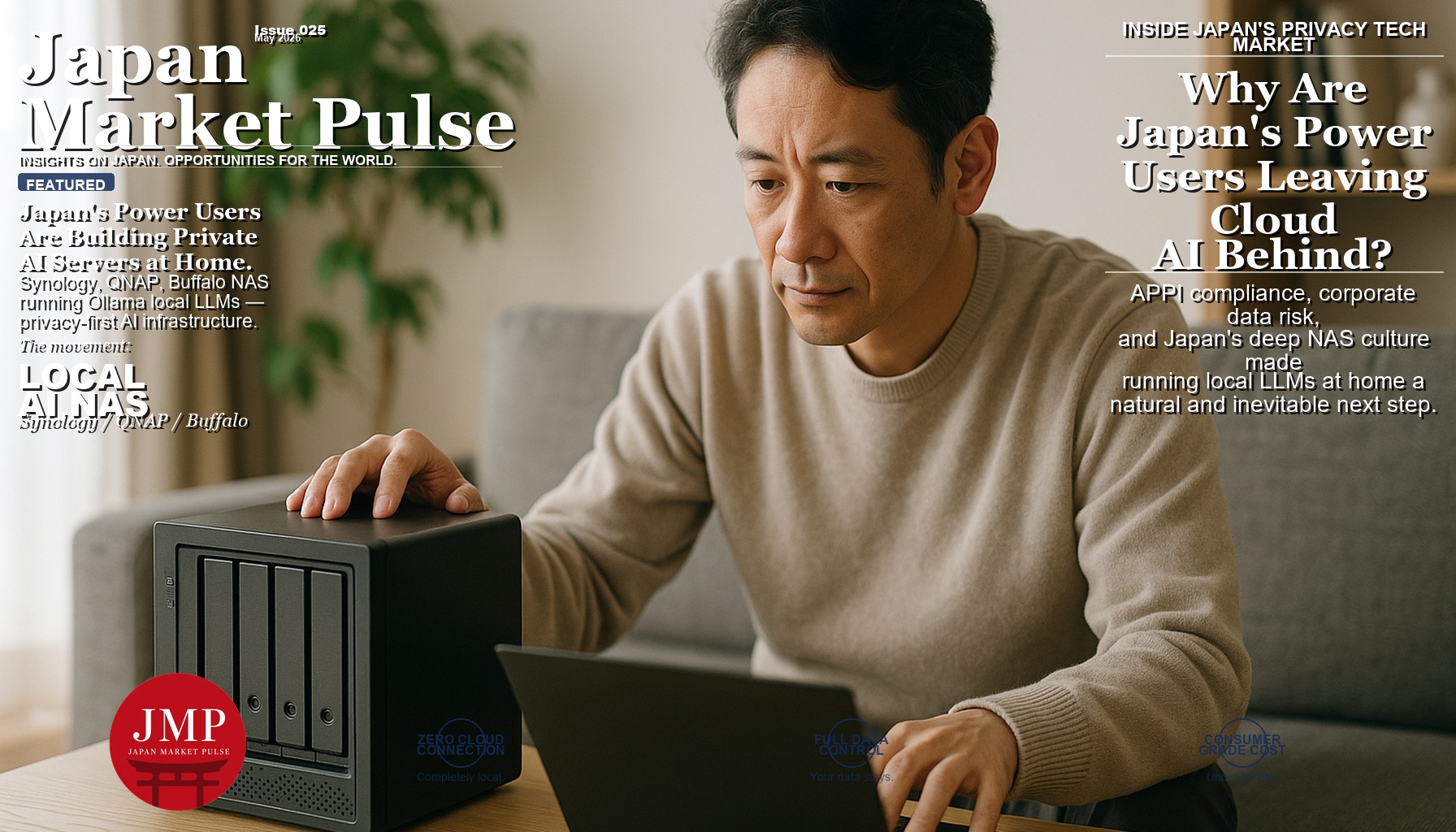
A software engineer in Setagaya has a Synology DS923+ sitting on a shelf next to his router. It has been there for three years, originally used for automatic backup of family photos and a Plex media server. Six months ago he loaded Ollama onto it, pulled down the Llama 3.1 8B model, and now uses it as a private AI assistant for work — drafting emails, summarizing meeting notes, processing documents that contain client data he is not comfortable sending to OpenAI’s servers. He gets 15-18 tokens per second. It is not ChatGPT. It is fast enough.
He is not unusual. Across Japanese tech forums, NAS community boards, and the kind of low-key Slack workspaces where serious hobbyists share configuration notes, the pattern is repeating: people who have had home NAS devices for years are now repurposing them as private AI inference servers. The trigger was the maturation of local LLM models — specifically the Llama 3 family, Mistral, and Microsoft’s Phi-3 — to a point where they run usably on consumer hardware without a GPU. The motivation, stated plainly and repeatedly in these communities, is privacy: “I don’t want my data on US servers.”
For anyone tracking the enterprise NAS market, the B2B implications of what Japan’s consumer NAS users are doing right now are significant. This is a pattern Japan has run before. When Japanese consumers built out home NAS infrastructure a decade ahead of equivalent Western adoption, it presaged a subsequent enterprise NAS boom. The current private AI server movement looks like the same pattern on a faster timeline.
Japan’s NAS Head Start: Why This Market Is the Right Place to Watch
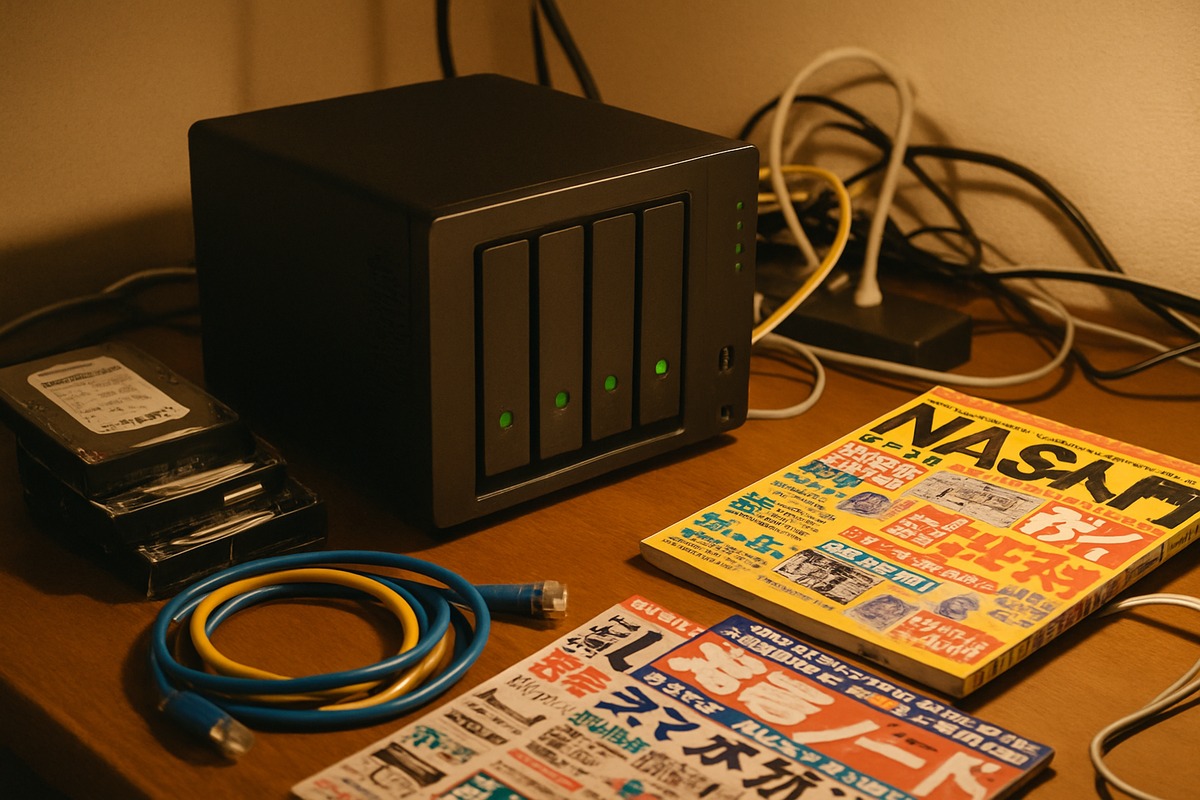
Japan’s relationship with home network storage predates most Western markets by a meaningful margin. The country’s consumer NAS market was already well-developed in the mid-2010s, when the concept was still primarily a technical enthusiast pursuit in the US and Europe.
The reasons are structural. Japan has extremely high home fiber penetration — over 80% of Japanese households with broadband connectivity have fiber-to-the-home, compared to roughly 20% in the US and around 35% in the UK. When your home connection is symmetric gigabit fiber, the economics of self-hosted network storage make more sense. Current estimates put the Japanese consumer NAS market at approximately 450,000 units per year, with Synology holding roughly 35% market share.
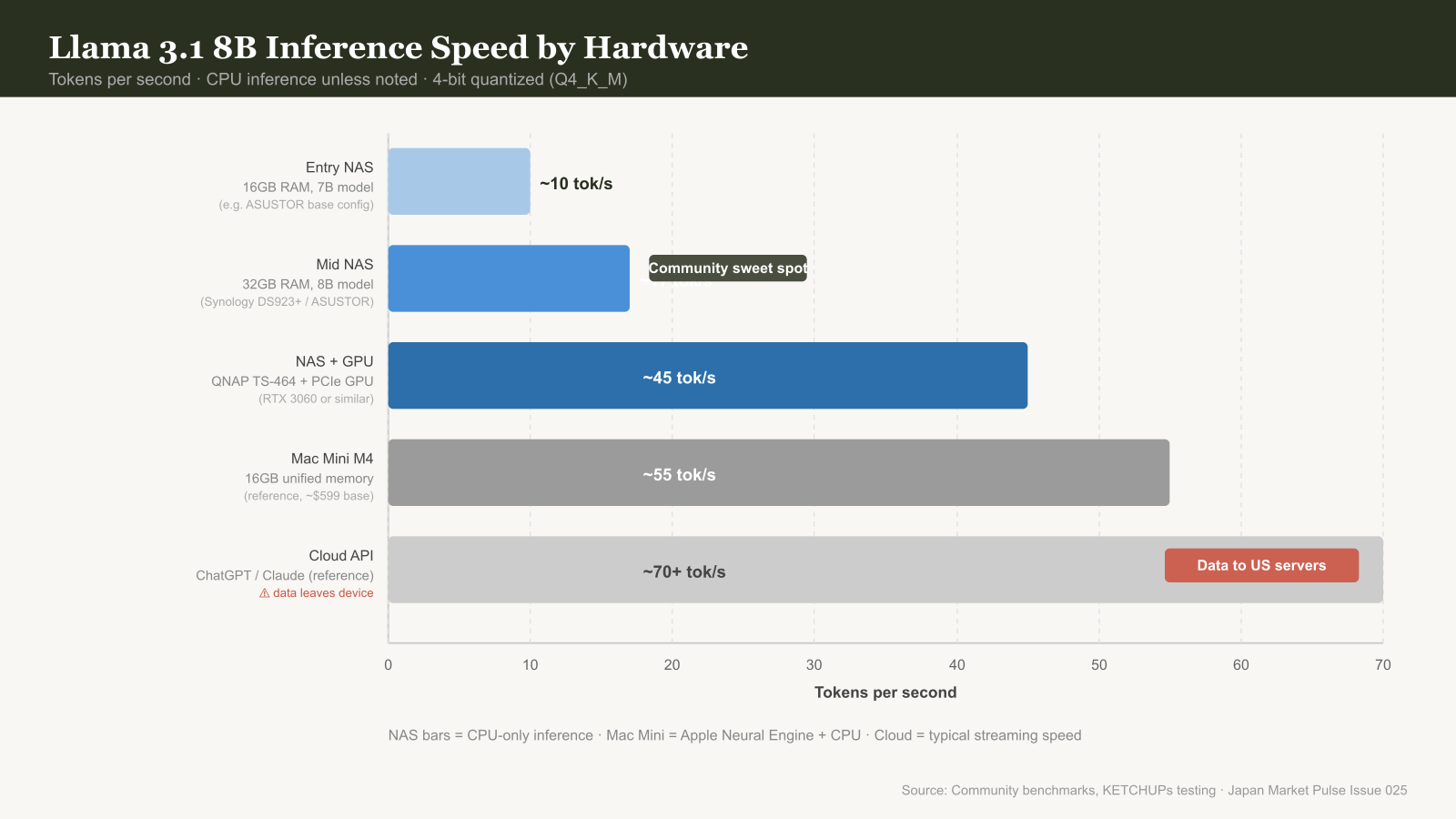
The leap from “home NAS for backups and media” to “home NAS as private AI server” required one enabling condition: local LLM models that fit in available RAM and run at usable speeds on CPU-only hardware. That condition was met in mid-2023 with the release of quantized Llama 2 models, and has been progressively better satisfied with each subsequent model generation. Llama 3.1 8B running via Ollama on a NAS with 32GB of RAM delivers 15-20 tokens per second — not instant, but entirely workable for document processing, email drafting, and knowledge base query tasks.
The Privacy Catalyst: Why Japanese Users Are Doing This
The technical feasibility was necessary but not sufficient. The motivation that is actually driving adoption in Japan is a specific, articulable privacy concern that shows up consistently in user-generated content about this topic.
Japanese power users have a well-documented reluctance to depend on US cloud services for data they consider sensitive. This is partly cultural: Japan has a strong tradition of data sovereignty thinking, reinforced by periodic news coverage of US government data access legislation, which tends to get more concerned coverage in Japanese media than in American outlets.
It is also partly legal and professional. Japan’s Personal Information Protection Act, substantially revised in 2022, imposes meaningful penalties for data breaches involving personal information. The 2022 revision added specific provisions around cross-border data transfers that made the question of “is this data being processed on a US server?” more legally salient for Japanese professionals.
The practical expression of this in NAS forums is direct. Users describe running client documents through their local Llama instance specifically because they do not want to expose client data to third-party AI services under foreign jurisdiction. In a country where corporate culture places high value on client confidentiality and where the professional consequences of a data incident are severe, the logic of a private AI server is not paranoia — it is rational risk management.
The Hardware Landscape: Three Devices Driving the Movement
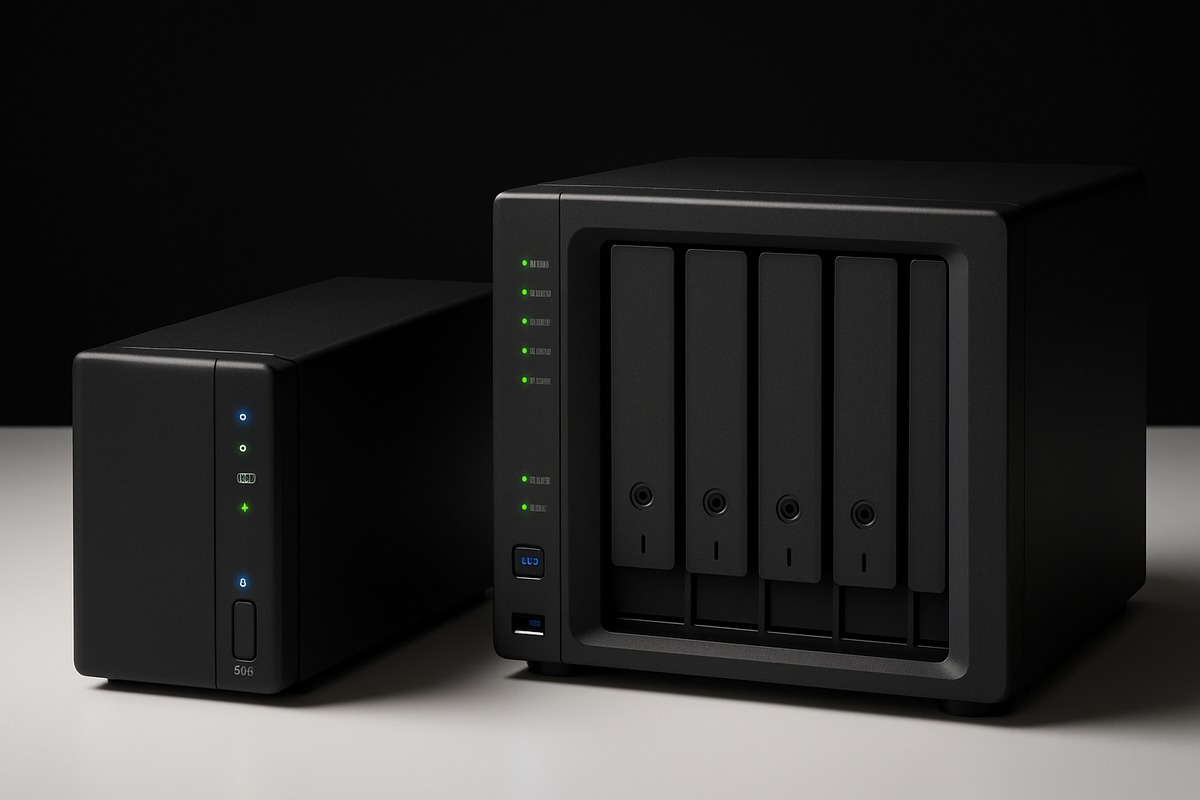
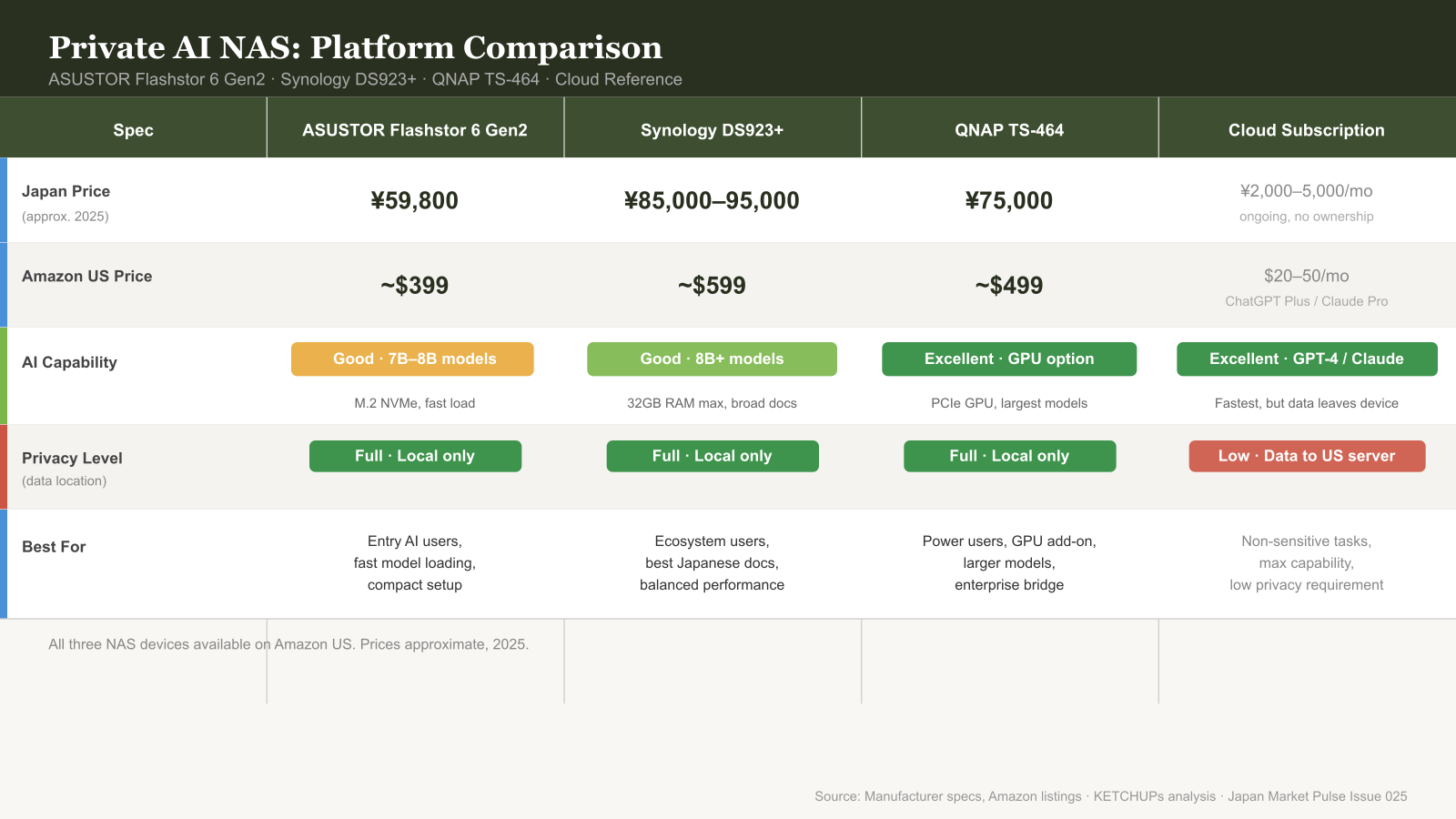
ASUSTOR Flashstor 6 Gen2 (¥59,800 / ~$400 on Amazon US) is the entry point for the AI-optimized segment. It uses M.2 NVMe slots rather than traditional spinning disk bays — a design choice that dramatically improves random read performance for loading model weights. The Flashstor line was explicitly positioned by ASUSTOR for AI inference workloads, making it the first consumer NAS to market itself directly at the local LLM use case.
Synology DS923+ (¥85,000-95,000 / ~$599 on Amazon US) is the established platform of choice for users who want a complete ecosystem. Synology’s DSM operating system is widely regarded as the most polished NAS software available, and the DS923+ benefits from the largest Japanese user community of any NAS platform — documentation, troubleshooting threads, and Ollama configuration guides in Japanese are more readily available for Synology than for competitors.
QNAP TS-464 (¥75,000 / ~$499 on Amazon US) occupies the most technically ambitious position. Unlike the other two platforms, the TS-464 supports external GPU connection via PCIe expansion, enabling genuine GPU-accelerated AI inference. For users running larger models or wanting to process more concurrent requests, this is the platform with the highest ceiling. All three devices are available on Amazon US.
The Software Stack: Ollama and Open WebUI as Enabling Infrastructure
The hardware is necessary but the software stack is what made private AI NAS practical for non-specialist users. Two open-source tools have done most of the work.
Ollama is a runtime that handles the complexity of running large language models locally — model download, quantization format handling, API endpoint exposure, and memory management — behind a clean command-line interface and a simple REST API. Open WebUI provides a ChatGPT-like browser interface that connects to a local Ollama instance. The combination produces a private AI assistant that looks and behaves like a hosted service but runs entirely on local hardware.
The tipping point for Japanese adoption was the emergence of Japanese-language documentation for this stack. NAS-specific setup guides in Japanese, covering Ollama installation on DSM (Synology’s OS) and QTS (QNAP’s OS), began appearing on Japanese tech blogs and community wikis in late 2023. The availability of this documentation in Japanese is a reliable proxy for when a technology crosses from imported Western early-adopter behavior into genuine Japanese mainstream enthusiast adoption.
Performance Reality: What 15 Tokens Per Second Actually Means
Fifteen tokens per second means roughly 11-15 words per second of output. At that rate, a 300-word response takes about 20-25 seconds to generate. For synchronous conversation this is noticeable latency. For document processing tasks where a user submits a long document for summarization and goes to make coffee while it runs, it is entirely acceptable.
The typical framing in Japanese community discussions is not “this is as good as ChatGPT” but rather “this is good enough for the tasks where I care about where my data goes.” That is a mature and precise articulation of a product’s value proposition, and it suggests a user community that has settled into a stable set of use cases rather than chasing performance parity with cloud AI.
The Adoption Timeline: Japan’s 18-Month Lead
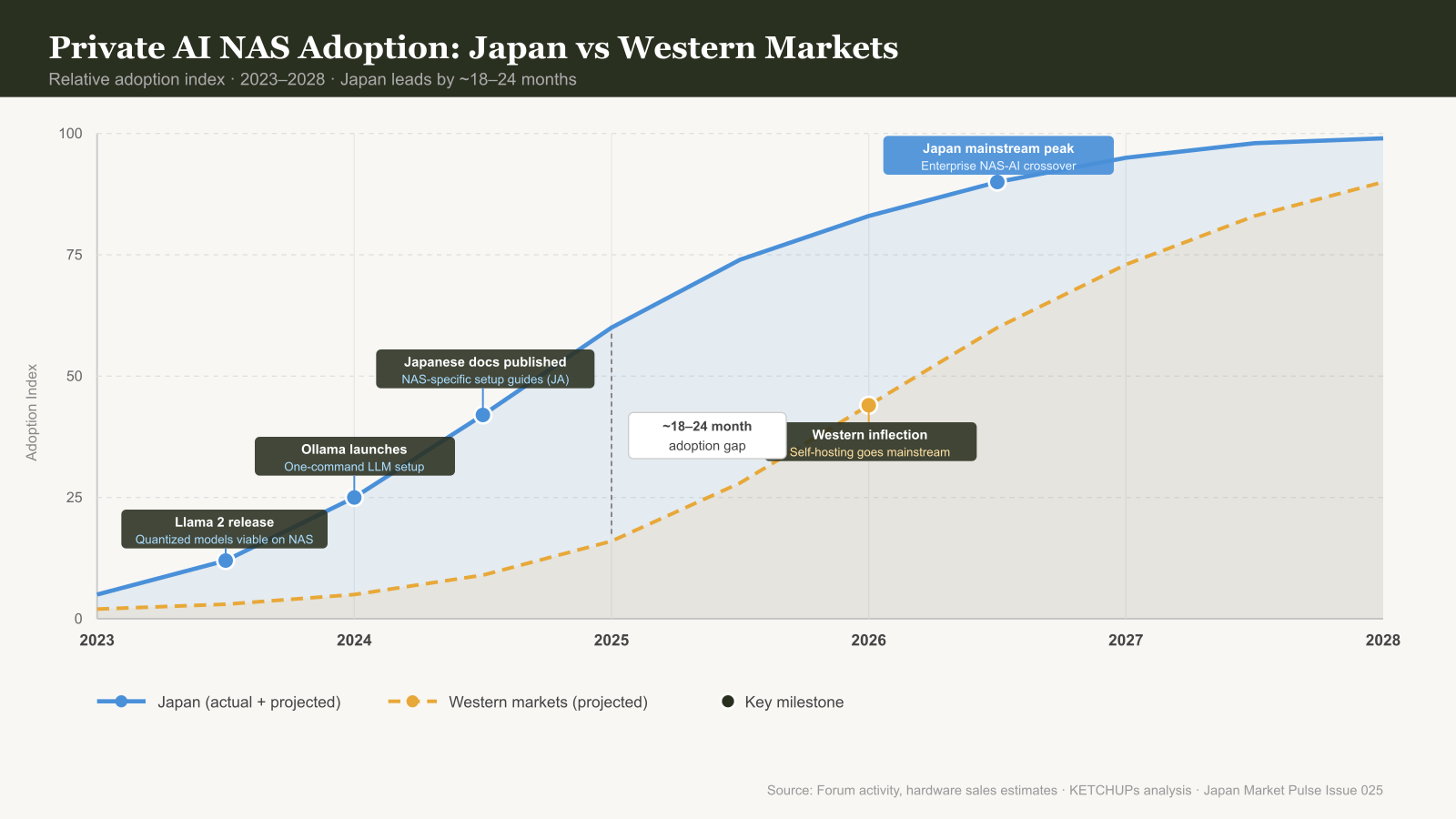
The evidence for Japan’s lead over Western markets in private AI NAS adoption comes from multiple sources. Forum activity, Japanese-language tutorial content volume, and hardware sales patterns in Japan all suggest that the movement has been in genuine growth since early 2024. Western equivalents — Reddit communities for Synology and QNAP, self-hosting forums — show interest in the same use case but at an earlier stage: more questions, fewer established workflows, less published configuration guidance.
NAS manufacturers’ behavior confirms it. ASUSTOR launched the Flashstor Gen2 with AI inference as an explicit positioning point, and the marketing localization for Japan was more detailed and earlier than for Western markets. Synology and QNAP have both published Japanese-language AI workload documentation that has no equivalent depth in English.
For Western operators, the practical implication is a window. The self-hosting and privacy-first computing communities in the US and Europe are growing — the Snowden-era distrust of cloud services never fully dissipated, and mainstream adoption of generative AI has renewed concerns about data exposure among professionals who did not previously think carefully about where their data went. The NAS-as-AI-server concept will reach these communities. The operators who build authority on the topic now will have an advantage when it does.
Japan’s private AI server movement is not a quirk of Japanese technology culture. It is a rational response to a specific set of conditions — mature LLM models, available hardware, articulable privacy risk — that are not unique to Japan. The conditions are arriving in the West on a slight delay. The pattern is already visible in what a software engineer in Setagaya is doing with his NAS on a Tuesday afternoon.
If you’re interested in this topic, the Japanese market more broadly, or what KETCHUPs is working on, we’d love to hear from you — please reach out via our contact form.
Japan Market Pulse is a weekly read on Japanese consumer trends, retail shifts, and market signals for B2B operators watching the market.
Subscribe at ketchups.co/japan-market-pulse.