
Disclosure: This article covers Japanese consumer-tech products. Some links are Amazon Associates US affiliate links — BOOX Note Air5 C, BOOX Palma 2 Pro. Fujitsu Quaderno is mentioned for category context (Japan-only).
After a decade of waiting, Kaleido 3 made color E-Ink real in 2025-26 — and the device landscape that followed tells an unexpected story about Japanese work, commute culture, and the global race between open platforms and domestic proprietary ecosystems.
Japan Market Pulse — Issue 015 | Gadget Watch
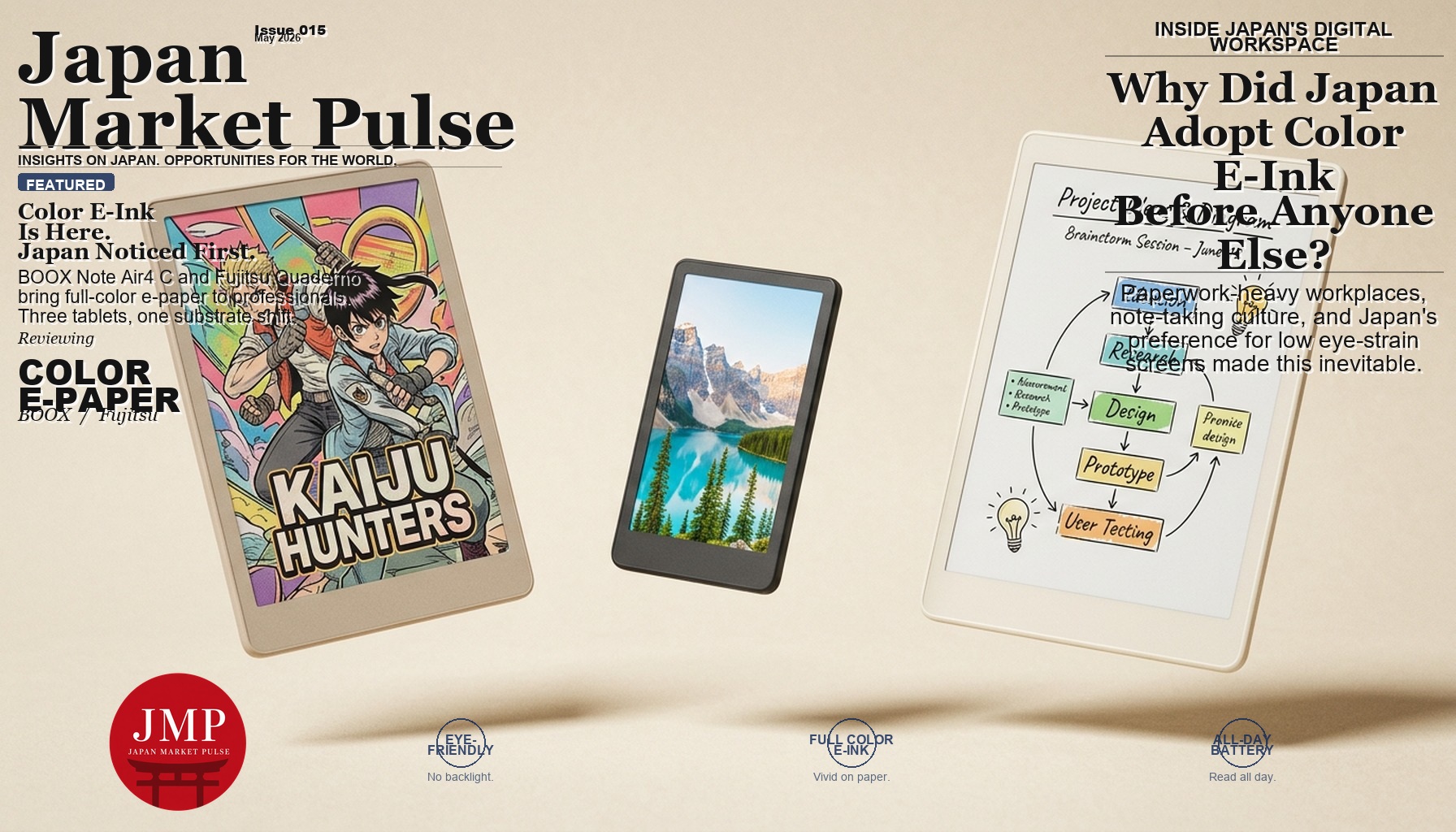
A confession to begin. The author has spent the better part of two years tracking Japanese consumer-tech adoption, and the strongest residual habit from that work is skepticism about claims that a technology is “finally here.” The phrase usually means one of two things: either it has arrived in quantity but not yet in quality, or it has arrived in quality but only in a form that requires wealth or patience the mass market does not possess. Color E-Ink — a technology that has technically existed for a decade — seemed likely to join that category. The path from monochrome E-Ink to true color at consumer scale is, it turns out, a longer road than anyone predicted. But in late 2025 and early 2026, the road ended. Kaleido 3, the color filter technology that finally achieved 4,096 color rendering on an E-Ink display, crossed the threshold from “promising prototype” to “real product you can buy today.” And the consumer who noticed first was not who most people expected.
Color E-Ink is not a technology in search of a use case anymore. It is a direct answer to how people actually work, read, and move in 2026.
Here is the story of how that happened, which companies are winning, and what the structure of the market reveals about the future of focus-work devices.
The Decade-Long Wait: Why E-Ink Stayed Monochrome Until Now
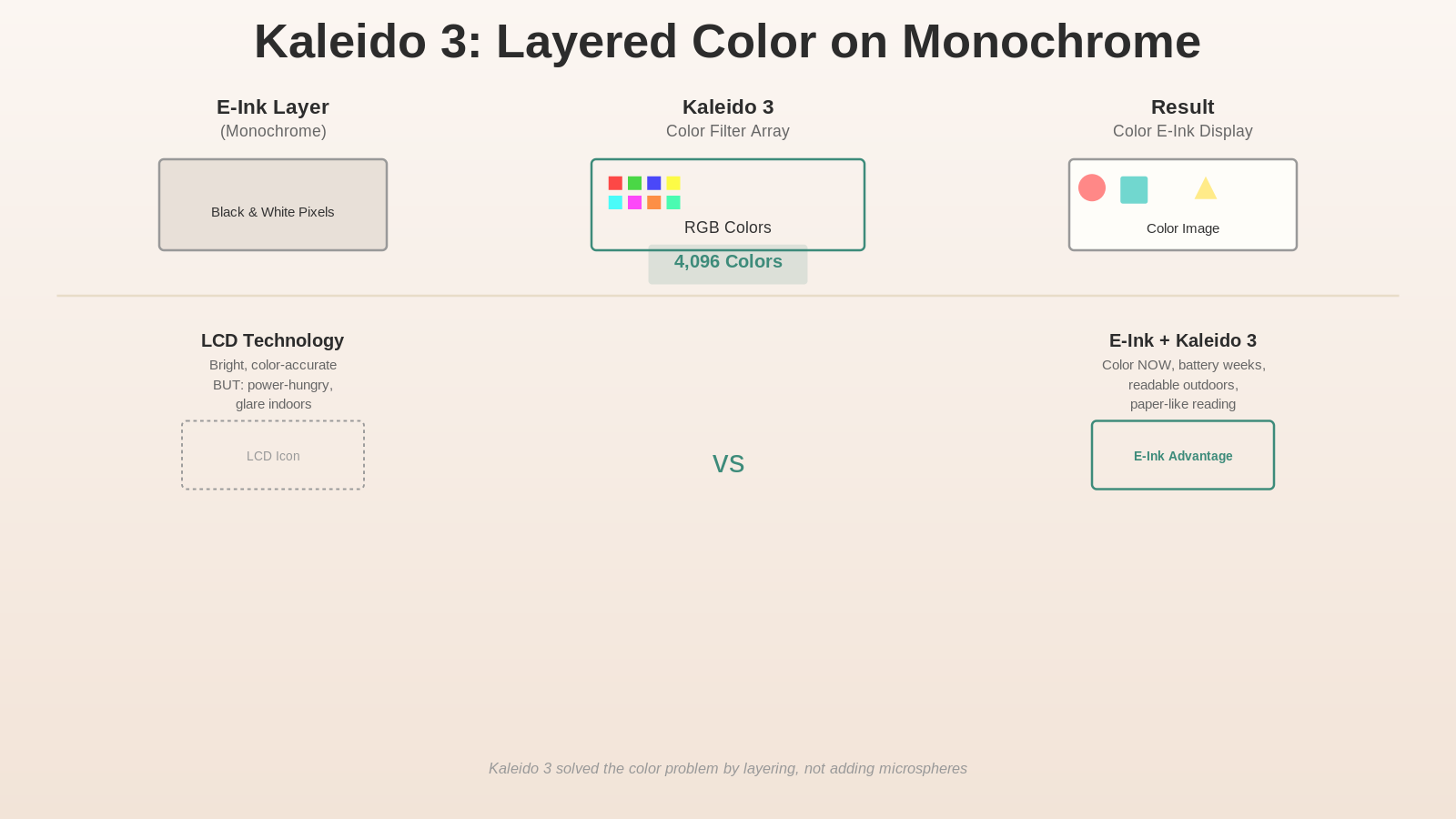 Kaleido 3’s solution: a color filter array on monochrome E-Ink achieves 4,096 colors without the refresh lag, power drain, or thickness increase of earlier systems.
The history of E-Ink color is a study in patience. Monochrome E-Ink technology — the display substrate that powers Amazon Kindles, e-readers, and certain smartwatches — has been commercially viable since the early 2000s. The appeal is obvious: the display consumes power only when the image changes, not while displaying a static image. It renders the printed page with a legibility advantage over LCD and OLED in bright outdoor light. It produces zero flicker. The problem with color was never the aspiration. It was the implementation. Early attempts at color E-Ink produced 16-color or 256-color systems that looked, by any honest technical assessment, like failure. The color fidelity was poor. The refresh rate was slow enough to make writing with a stylus feel laggy. The price premium was steep. The use case — if color E-Ink was so desirable, why did Amazon Kindle e-readers (which command a dominant global market share) not ship with it?
The answer is structural. Amazon Kindle dominates the e-reader market because the e-reader’s job is straightforward: display text and images in monochrome or gray-scale over long battery life. Adding color would require more circuitry, a thicker display stack, and a price increase that would price the product out of the mass market. The Kindle’s moat is built on simplicity and price. Color compromises both.
Then Kaleido happened. Kaleido 3 — released by Kaleido in 2024-25, now appearing in consumer products in Q1 2026 — solved the color problem through a different approach. Instead of trying to add multiple colored microspheres to each display pixel (the approach earlier color E-Ink systems used), Kaleido layered a color filter array on top of a monochrome E-Ink display. The result: 4,096 colors without the refresh-rate lag, the power consumption spike, or the thickness increase of earlier systems. The display stayed recognizable as E-Ink. The battery life stayed measured in weeks, not days. The color looked real.
And Japan noticed.
Why Japan Was First: PDF Workflows, A4 Culture, and the Long Commute
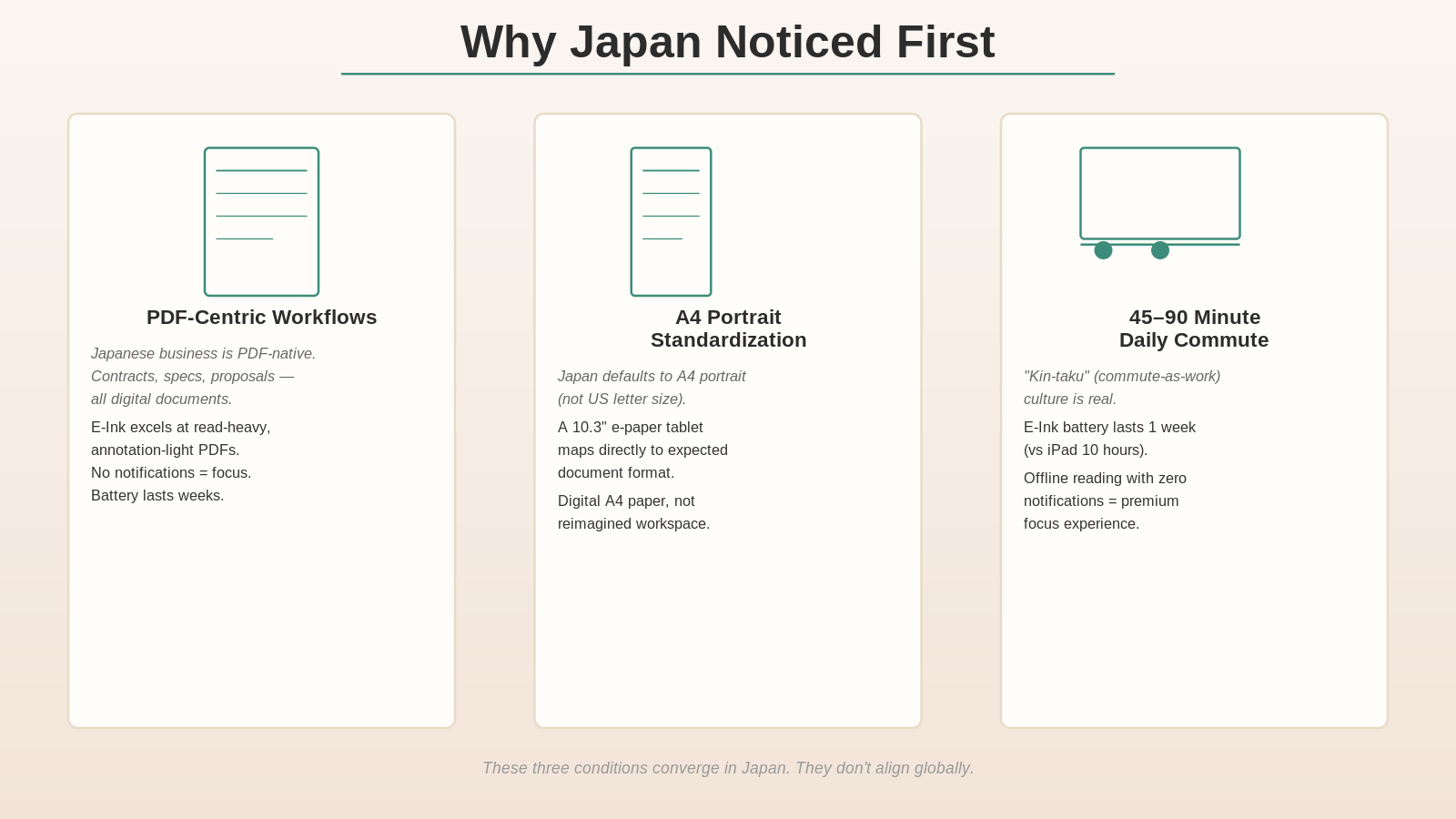 Why Japan’s professionals were first to adopt color E-Ink: PDF-centric workflows, A4 portrait standardization, and 45–90 minute daily commutes create a convergence that doesn’t exist globally.
To understand why Japanese professionals and students were the first consumer segment to recognize the value of color E-Ink, it helps to understand how Japanese work is structured. Three interlocking factors matter: document workflow, display format, and mobility. Together, they create a set of conditions that E-Ink solves in ways LCD and OLED do not.
Document workflow. The Japanese office runs on PDF. Contracts, proposals, project specifications, client documents — everything arrives as a PDF file. The typical workflow involves opening the PDF on a computer screen, reading it with care (often taking notes or marking it), and occasionally needing to reference it days or weeks later. This is a read-heavy, annotation-light workflow. It is not a “consume visual media in full color” workflow. It is a “read dense text with reference diagrams, preserve battery, and do not get distracted by notifications” workflow. E-Ink is built for exactly this pattern.
Display format. Japan standardizes on A4 portrait. The default paper size in Japanese business, publishing, and education is A4, portrait-oriented. This is true for books, magazines, documents, and architectural designs. The tablet that maps directly to this workflow is a 10-inch-class device in portrait orientation. A 10.3-inch E-Ink tablet with a stylus is, structurally, a digital piece of A4 paper. Matching the expected format of analog work — not reimagining it, just digitalizing it — has a deep appeal in Japanese business culture.
Mobility and battery. The average commute in Tokyo (and most major Japanese cities) is 45–90 minutes one way. The phenomenon of “kin-taku” (, “working from commute”) is real: salarymen and students use commute time to read documents, study, take notes, or write. They do this without opening their laptop. An 10-inch tablet with a week’s battery life enables this workflow in a way an iPad cannot (iPad battery lasts 10–12 hours of active use). A pocket-size 6-inch E-Ink device (the BOOX Palma 2 Pro) enables a completely new category: offline reading and note-taking with zero notification pressure.
These three conditions — PDF workflow, A4 standardization, and mobile-first time use — do not exist in most Western business environments in the same combination. Germany standardizes on A4, but German business is less PDF-centric and commute times are different. The United States is hyper-mobile but standardizes on letter-size paper. Japan’s combination of all three is globally rare. It is therefore unsurprising that when color E-Ink finally became real, Japan was where it found its first sophisticated consumer segment.
BOOX Note Air5 C: The Global-Ambitious Flagship
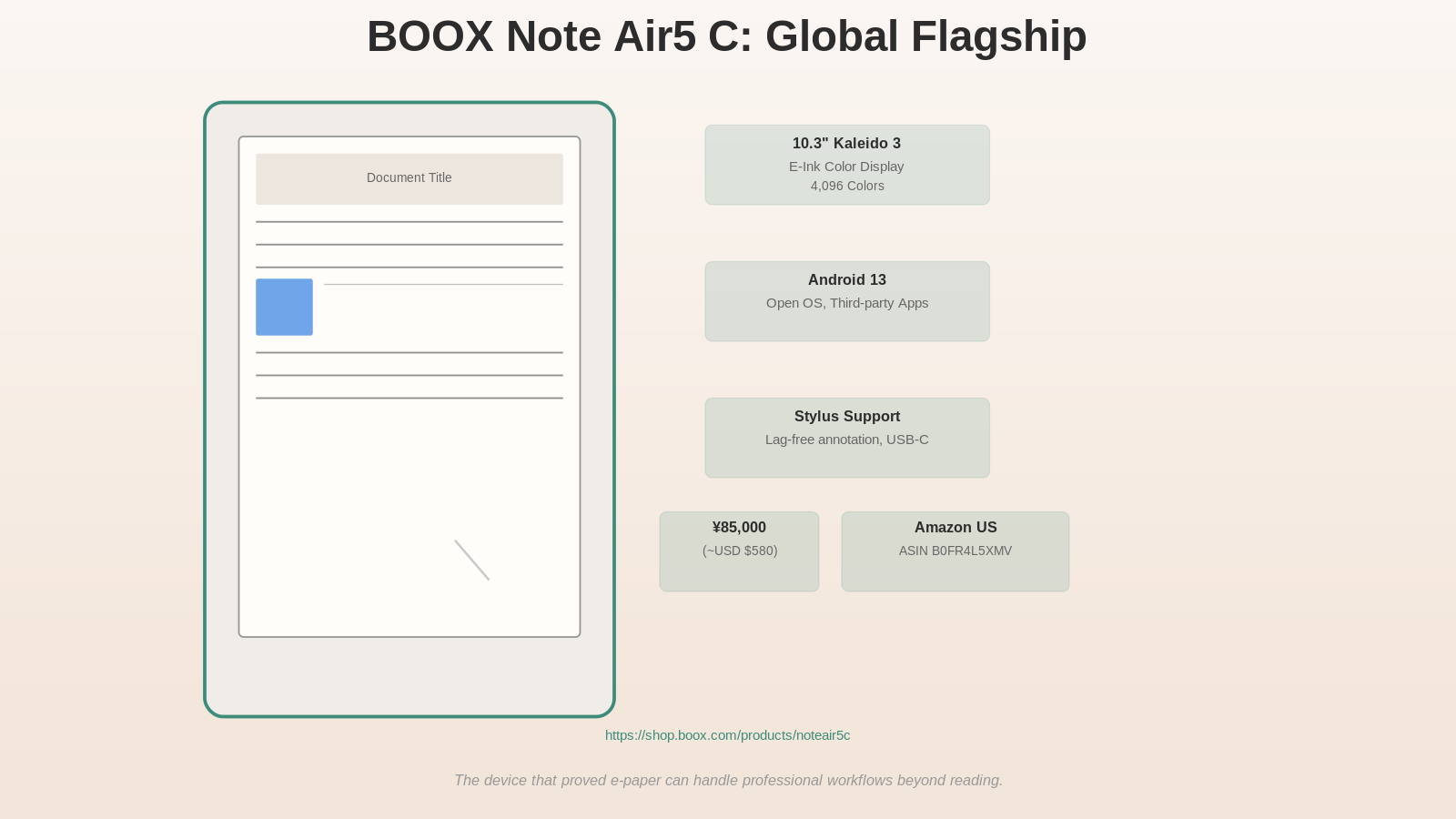 BOOX Note Air5 C: the global-ambition flagship. Open Android OS, Kaleido 3 color E-Ink, Amazon US distribution, stylus support. The device that proved e-paper can handle professional workflows beyond reading.
BOOX (Onyx International) Note Air5 C. ¥85,000. 10.3-inch Kaleido 3 E-Ink display. Android 13 native OS. Available on Amazon US via ASIN B0FR4L5XMV.
The Note Air5 C is the product that proved color E-Ink could do more than display photographs. In the GetNavi May 2026 issue (pages 24–25), reviewer Yuasa Akihito subjected the Note Air5 C to a four-scenario real-world test: document reading, work annotation, commute use, and outdoor legibility. What is striking is that all four work. There is no scenario in which the product falls short. This is not true of iPad. The iPad is excellent at work and document reading, but it is poor at commute use (battery drains in hours) and has no advantage outdoors. The E-Ink device excels at a different optimization curve.
The four scenarios revealed that color E-Ink is no longer a niche product for e-reader enthusiasts. It is a direct answer to a professional segment that genuinely exists — people who need a “second screen for focus work,” not a replacement for a laptop or phone. The global implications are clear: BOOX is not marketing a reader, it is marketing a productivity device.
The open Android ecosystem is strategically important here. Unlike the iPad (which can be configured for productivity but is fundamentally a consumption device) or the Kindle (which is explicitly a reader), the BOOX Note Air5 C allows users to install third-party note apps, PDF readers, email clients, and even media players. This openness is not accidental. BOOX’s global ambition is to own the “second-screen productivity” niche internationally. The Amazon US affiliate link is no accident — BOOX is building Western distribution.
BOOX Palma 2 Pro: The Pocket E-Ink Surprise
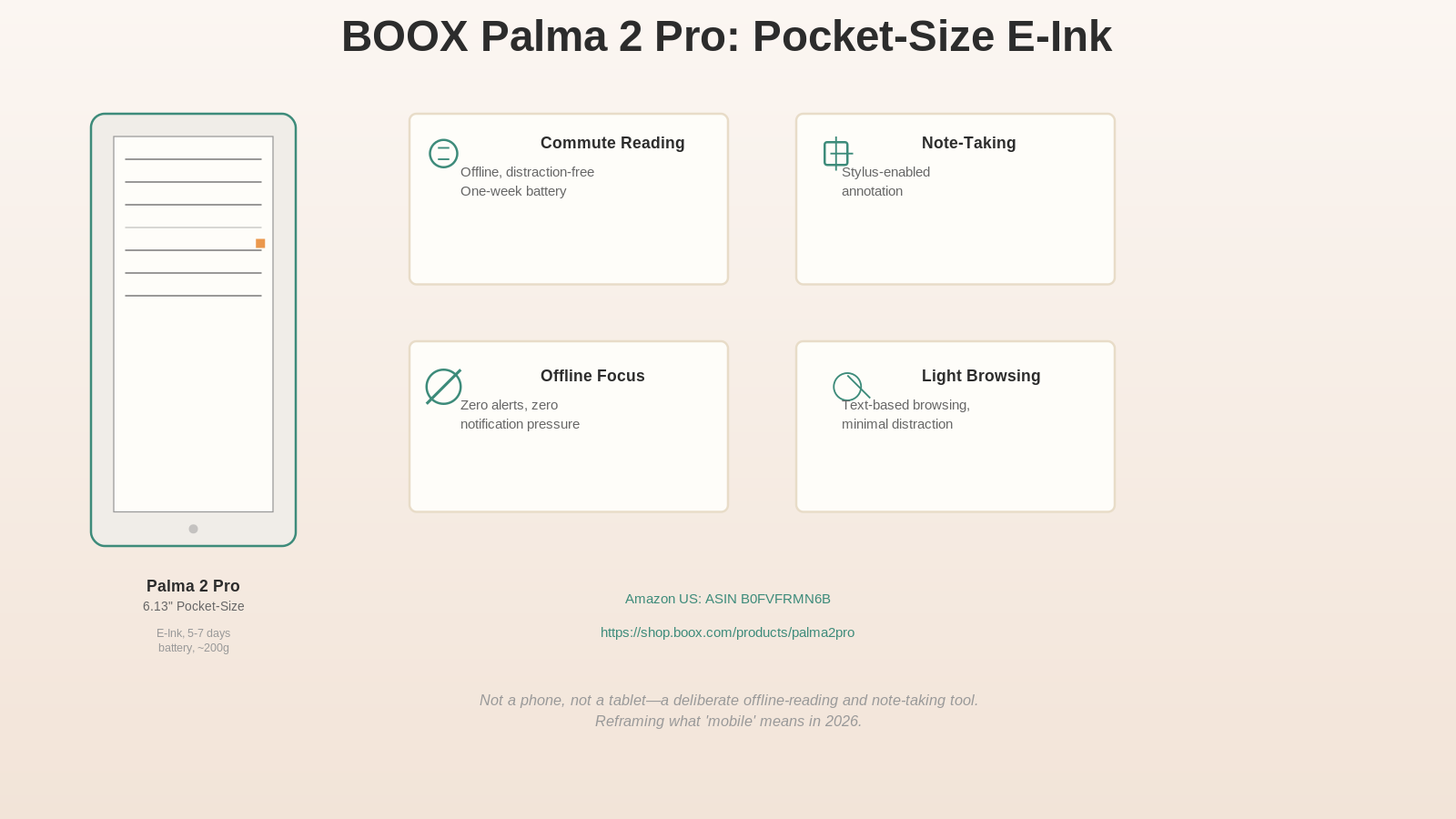 BOOX Palma 2 Pro: not a phone, not a tablet—a deliberate offline-reading and note-taking tool. 6.13″ E-Ink, 5-7 day battery, zero notifications by design. Reframing what ‘mobile’ means.
6.13 inches. Amazon US ASIN B0FVFRMN6B. Monochrome E-Ink (not color), but the story is even more interesting than the flagship.
The Palma 2 Pro is not a phone. It looks like a phone — it has the dimensions of a mid-size Android device — but its purpose is fundamentally different. The screen is 6.13 inches of E-Ink, optimized for reading and note-taking. The OS is Android, but the implied use case is offline. Battery lasts 5–7 days. It weighs less than 200 grams. The price is roughly ¥30,000–¥40,000.
BOOX likely expected this product to appeal to e-reader enthusiasts who wanted something larger than a Kindle but smaller than a tablet. What actually happened was more interesting. Japanese consumers adopted the Palma 2 Pro as an offline-reading and note-taking device for commute time. Not as a replacement for their smartphone (they still carry both), but as a deliberate “focus tool” that has no notifications, no email, no social media, no weather alerts. The device forces offline behavior.
This is a psychological shift worth noting. The Palma 2 Pro is not winning because it is the best device at any single task. It is winning because it is deliberately, structurally, undistracting. In an era where “digital wellbeing” and “focus time” have become recognized professional needs, a device that literally cannot receive notifications is a form of professional hygiene.
Fujitsu Quaderno: Japan’s Proprietary Premium Alternative
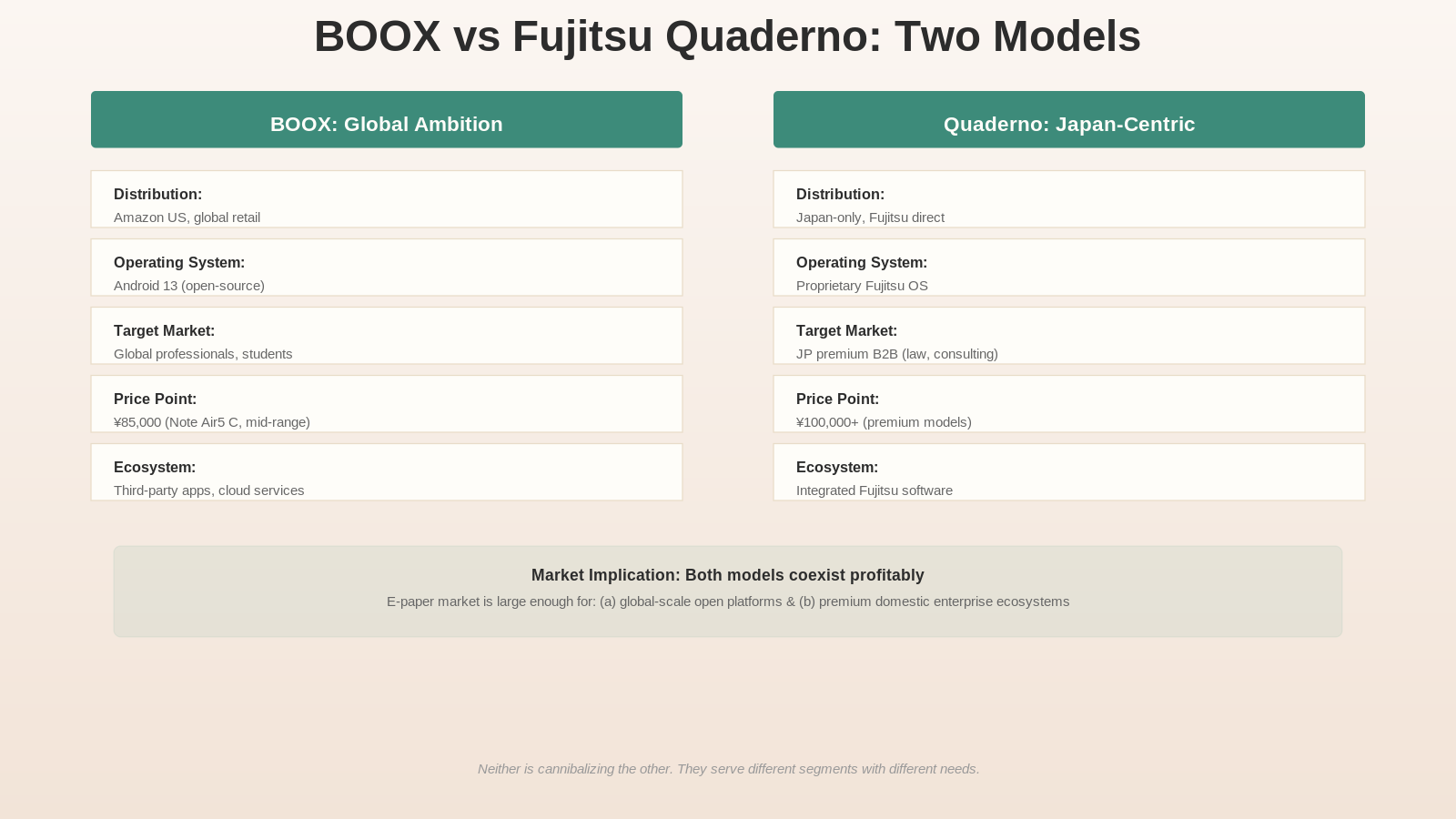 Two parallel business models coexist: BOOX’s global-scale open platform and Quaderno’s Japan-centric proprietary enterprise ecosystem. Both are winning in their segments.
Fujitsu Quaderno. A4 and A5 form factors. E-Ink display. Stylus support. Available exclusively in Japan through Fujitsu’s direct channels.
The structural contrast with BOOX is stark. Where BOOX is globally ambitious, internationally distributed, running open-source Android, and building AWS-scale cloud infrastructure, Fujitsu Quaderno is nationally closed, domestically distributed, running proprietary Fujitsu OS, and architected for enterprise Japanese customers — legal offices, consulting firms, hospitals, government ministries.
Quaderno’s price positioning is higher than BOOX (premium models exceed ¥100,000). Its target customer is explicitly the high-end professional who will not shop on Amazon and expects integrated enterprise support, Japanese legal compliance, and seamless integration with Fujitsu’s PC business software stack.
The existence of both players is strategically instructive. It suggests that the e-paper-tablet market is large enough to support at least two business models: BOOX’s “open platform, global scale, Amazon distribution” approach and Quaderno’s “proprietary ecosystem, domestic focus, enterprise lock-in” approach. Neither is cannibalizing the other. They are serving different customer segments with different needs.
The Reviewer’s Verdict: What Four Use Cases Reveal About Form Factor
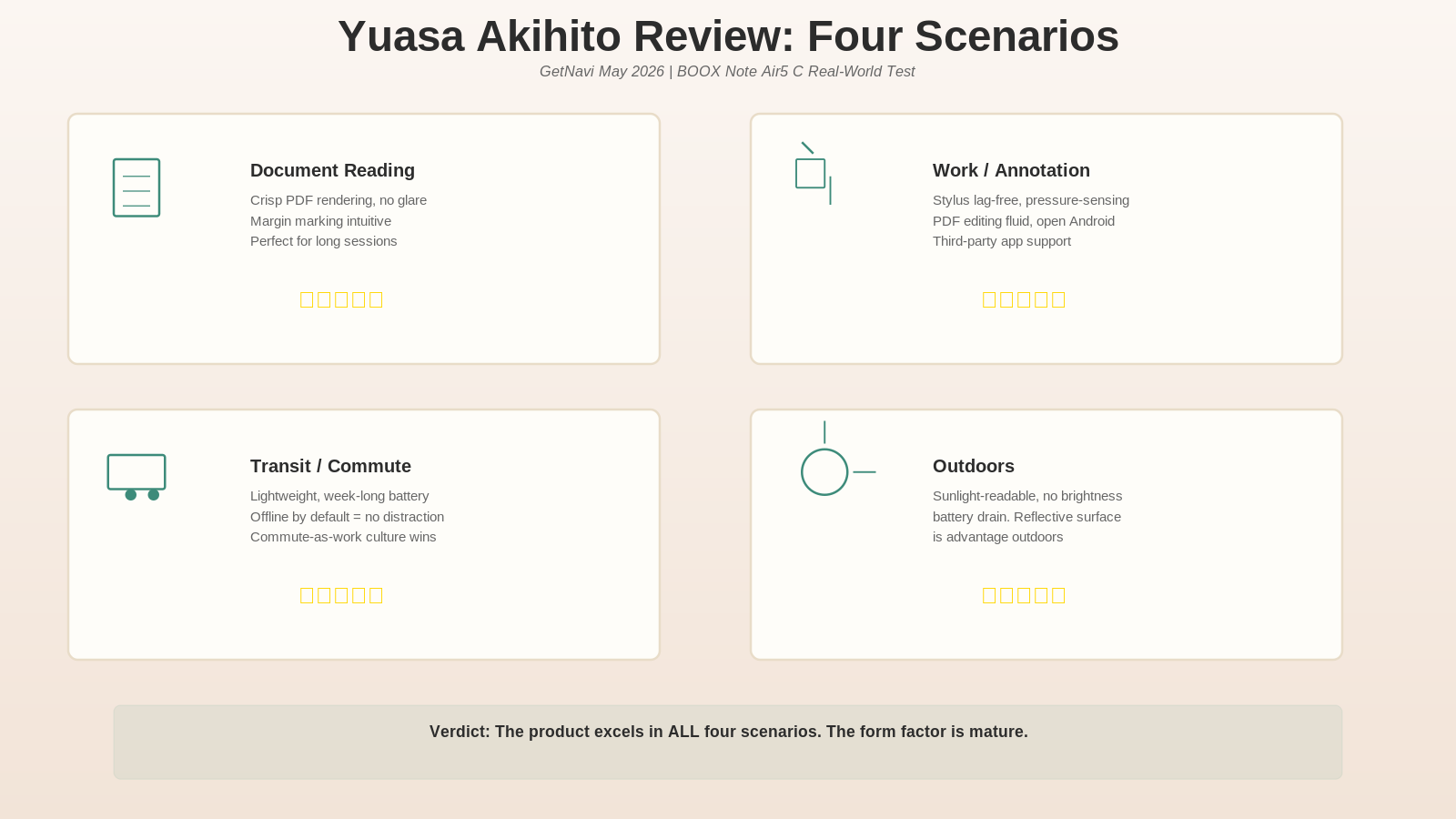 Yuasa’s verdict: the BOOX Note Air5 C excels across all four real-world scenarios. The form factor is mature. Color E-Ink is no longer a niche product.
Yuasa’s four-scenario test in GetNavi (p.25) is worth unpacking in detail, because it reveals something fundamental about why e-paper tablets are not just niche products anymore. The four modes are: (1) Document Reading — crisp, no glare, margin-marking natural; (2) Work — annotation, PDF editing, pen responsiveness; (3) Transit — lightweight, battery week-scale, distraction-free; (4) Outdoors — sunlight-readable, no brightness battery drain.
What is striking is that all four work. There is no scenario in which the product falls short. The implication is that the form factor is mature. Color E-Ink is no longer “interesting prototype.” It is “serious tool.” This matters because it suggests the market will expand beyond early adopters.
What This Means for International Operators
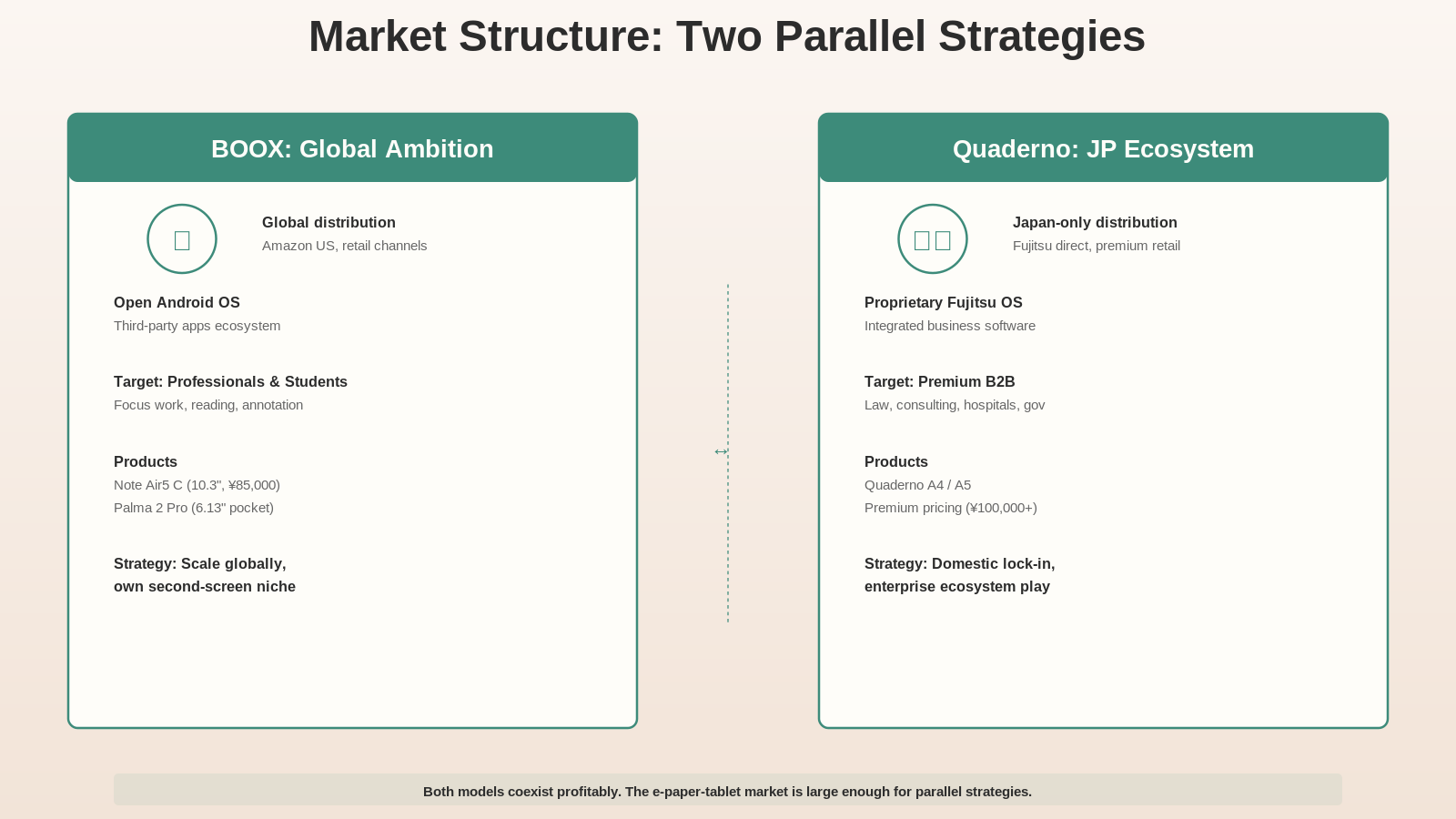 The e-paper-tablet market structure: room for global-scale open platforms (BOOX) and premium domestic-ecosystem enterprises (Quaderno). Both strategies work.
For English-language readers outside Japan, three implications are worth considering.
First: the “second screen for focus work” is a real market segment. Professionals who want a device for reading, annotating, and taking notes — a device that explicitly does not distract — now have a category of products. BOOX is already selling globally. The product is available on Amazon US. The price is real (¥85,000 is roughly USD $580). The battery life is measured in weeks. The open Android ecosystem means developers will build apps. This category will grow.
Second: pocket-size E-Ink devices reframe what “offline” means. The Palma 2 Pro is not a phone alternative. It is a deliberate analog-adjacent device. In an era of constant connectivity, a device that forces offline use has psychological value. Japanese companies have recognized this. Western companies should expect to see investment in similar form factors.
Third: Japan’s market segmentation reveals the future. BOOX and Quaderno are not competitors in the economic sense — they serve different customer bases. But together, they show that the e-paper-tablet market has room for: (a) global-scale, open-ecosystem devices distributed through retail (BOOX), and (b) premium, proprietary, domestically-focused enterprise solutions (Quaderno). This structure will likely repeat in other markets as e-paper matures.
TL;DR — What to Watch
If you want to see the global player: BOOX Note Air5 C on Amazon US (ASIN B0FR4L5XMV, ¥85,000 ~USD $580 equivalent). The 10.3-inch Kaleido 3 display and open Android ecosystem are the blueprint for the global e-paper-tablet future.
If you want to see the pocket-size use case: BOOX Palma 2 Pro (ASIN B0FVFRMN6B). The 6.13-inch form factor and offline-by-design philosophy are reshaping what professionals think a mobile device should do.
If you want to see Japan’s premium-domestic approach: Fujitsu Quaderno (Japan-only). The proprietary ecosystem and enterprise positioning show a parallel path.
If you are an international operator evaluating Japan: the conditions that produced e-paper adoption in 2025-26 — PDF-centric workflows, A4 standardization, long-commute mobility, and the demand for focus-time tools — apply equally to professional segments in other developed markets. BOOX is already distributing globally. The window to understand this product category and decide whether it fits your market is, today, open. The e-paper-tablet market did not exist as a consumer category in 2022. In 2026, it is real.
Japan Market Pulse is a weekly read on what the Japanese consumer-tech, food, and mobility markets are choosing to do, written for international operators who want to know what is happening before it shows up in the global trade press.
Subscribe at ketchups.co/japan-market-pulse.
Sources
- BOOX Note Air5 C (Onyx International) — Official product page
- BOOX Palma 2 Pro (Onyx International) — Official product page
- Fujitsu Quaderno — Official product page (Japan)
- BOOX Note Air5 C on Amazon US (ASIN B0FR4L5XMV)
- BOOX Palma 2 Pro on Amazon US (ASIN B0FVFRMN6B)
- GetNavi 20265、p.24-25 — Color E-Paper Tablets Feature
- GetNavi reviewer: Yuasa Akihito — BOOX Note Air5 C Four-Scenario Real-World Test
If you’re interested in this topic, the Japanese market more broadly, or what KETCHUPs is working on, we’d love to hear from you — please reach out via our contact form.
If you’re interested in this topic, the Japanese market more broadly, or what KETCHUPs is working on, we’d love to hear from you — please reach out via our contact form.
Japan Market Pulse is a weekly read on what the Japanese consumer-tech, food, and mobility markets are choosing to do, written for international operators who want to know what is happening before it shows up in the global trade press.
Subscribe at ketchups.co/japan-market-pulse.